Showing posts with label Religion. Show all posts

Monday, 26 March 2018

Romanian Holiday Spirit: what You Should Expect if You Spend Easter in Romania


  Easter is coming. Although judging by looking out of the window and contemplating the (still) snowy landscape , we would rather think that Easter and Christmas have swapped places this year. But, it's the truth: on the 8th of April, we are celebrating Easter. Please note that, although Romanians  celebrate Christmas on the 25th of December, we celebrate Easter on the old Orthodox calendar, which in some years coincides with the non-Orthodox world, but most often it doesn't. 

         So, we have less than two weeks to go, and I'm inviting you to spend Easter in Romania. What is happening exactly?

The Church Service

Compared to Christmas, Easter has a higher degree of religious solemnity about it. Because the most important moment is the Resurrection sermon, held at night between Saturday and Sunday. So, we go to church at night, and the service is held outside the church, in the open air. At midnight, when it is said that Christ has resurrected, the priest spreads the holy light (which arrives every year from Israel), by lighting the candles of some participants at the ceremony, which, in turn, light each other's candles. After the service is over, we are all heading home with the lit candles, and we have to make sure they stay lit until we get home.


Now, you know me: I'm not the most religious person you'll meet in your life, but this is one of the few occasions when I want to go to church. Because it gives a special feeling, which one can understand just by being there. Plus, it is also a socializing event: it's impossible not to bump into relatives, neighbours, aquaintances, and even start talking to new people. 


The Food

So, after we get back home at night, what do we do? Of course, you guessed: eat! And yes, also at night, not just on the Easter Sunday lunch time. 

What is indispensable from the Easter feast?

- coloured eggs: 

There is special egg paint, in which eggs must be boiled so that the egg shell changes colour. They should be mainly red (symoblizing the blood of Christ), but you can make as many colours as you like. Plus, in some parts of the country, or the country side, or people who have more patience and skill also make drawings on the egg shell.


- lamb dishes:

Lamb soup, roast lamb, drob (minced meat pudding, made with lamb organs), stufat (lamb stew made with spring onios and spring garlic). Not everyone likes lamb, and not everyone wants to eat lamb for emotional reasons, but I can't think of any traditional Easter dishes without lamb. 

- pasca:

Typical Easter dessert, a sweet cheese pie made with cream cheese, raisins and vanilla flavour.


The People

Easter, just like Christmas, is spent with family and close friends, visiting each other at Sunday lunch. People greet each other with the phrase 'Christos a înviat!' (Christ has resurrected) and the other person has to reply 'Adevărat a înviat!' (Truly He has resurrected). It is not a very 'music and party' atmosphere, but just an occasion to be together. 

So, in the end, what we hope now is that the weather will be on our side, at least a little. Because otherwise we'll find Santa Claus, and a pot of sarmale instead! Anyway, I will wish you Paște Fericit, because I like to believe that this is what is happening after all! ;)

Sunday, 15 October 2017

Helsinki: the City where You Recharge Your Batteries (Part 2)


       Last time I shared with you some general thoughts about Helsinki, its vibe as a city, and some cultural characteristics and quirks of the Finns as a nation. And today we shall proceed with visiting the most important tourist attractions of the city. Public transport is quite easy to use, and I would advise you to buy a ticket that is valid for the whole transport network, both over and underground, accross the entire city. I paid 22 euros for a 4 days' pass. Convenient, I would say. Another practical advice is to have a map of the city with you, in order to get a global view of all tourist attractions and where each of them is situated, as well as which bus, tram or metro station is the closest. I must say that unfortunately tourist attractions are not very well signalled and, more often than not, in order to find your way, you have to either be accompanied by a local, either have a map, either ask passers-by. Or possibly all 3. :)
        The first stopover will probably be at the Kaisaniemi metro station, close to the University of Helsinki, from where you will be within walking distance from one of the most famous images of the city. 


This is the Helsinki Cathedral overlooking the Senate Square, from which you walk downhill towards the Esplanadi Park, and then the Market Square, located in the Helsinki Port, and where you can buy traditional food, souvenirs and Finnish artefacts. 


From there, you move a little further away towars the Uspenski Orthodox Cathedral, the biggest of this kind in a country where the main religion is not Orthodoxy. 


     One metro stop further, you will get to the Central Railway Station (Rautatientori), which is already in itself an impressive building. 


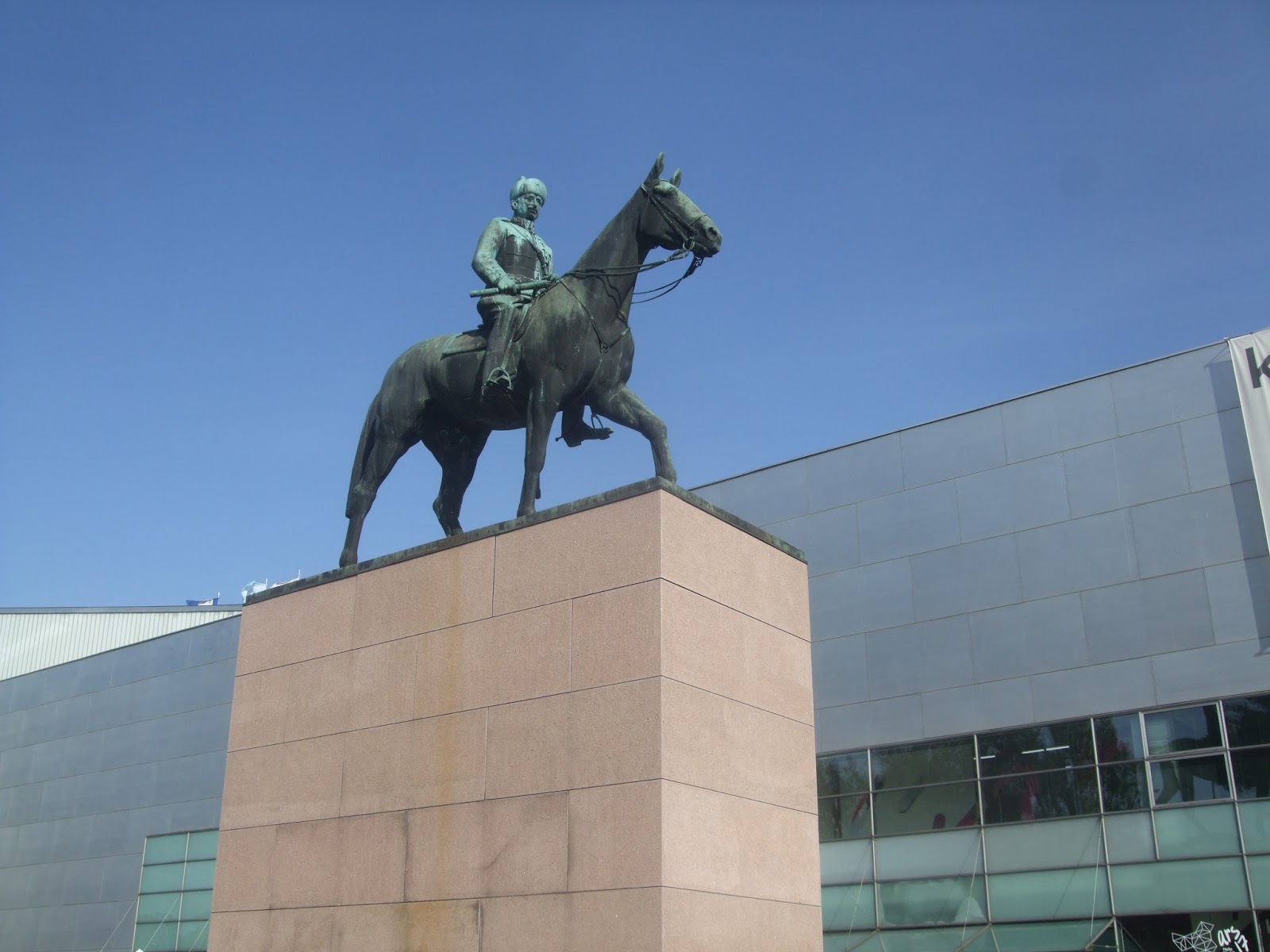
And from there, you can take a stroll on Mannerheimintie, one of Helsinki's most important boulevards, dedicated to Carl Gustaf Mannerheim, Finland's most important politician and former President. We will skip the 2 key museums on this boulevard, as we leave them for next time. After all, we save the best for last. But I will let you take a longer stroll, and hopefully enjoying a nice weather, just like I did on that day. 


          As you reach the Parliament House, you will need to take the streets behind it and try to find the mysterious Rock Church, which does a very good job at hiding from tourists. Here, the map will come in very handy. 


From the outside, this place looks like a cave, and moreover, the main entrance is not in the spot that you will find first. That is just the entrance to the garage, and from there you will still have a little bit to walk. But you will find it eventually. Outside it is still a cave, but inside it is a church: small and simple, decorated with rock and wood, yet packed with tourists. 


It's not that church where you can find inner peace, precisely because of how crowded it is, so the best you can do is find a few good spots to take pictures, light a candle for your loved ones, and leave. 
         So, you will find yourself in Mannerheimintie again. I trust that you will find your way back, because I know you have a map. ;) And you will go up the road, and enjoy a long walk or take the tram, depends on the weather and on how tired you are. 


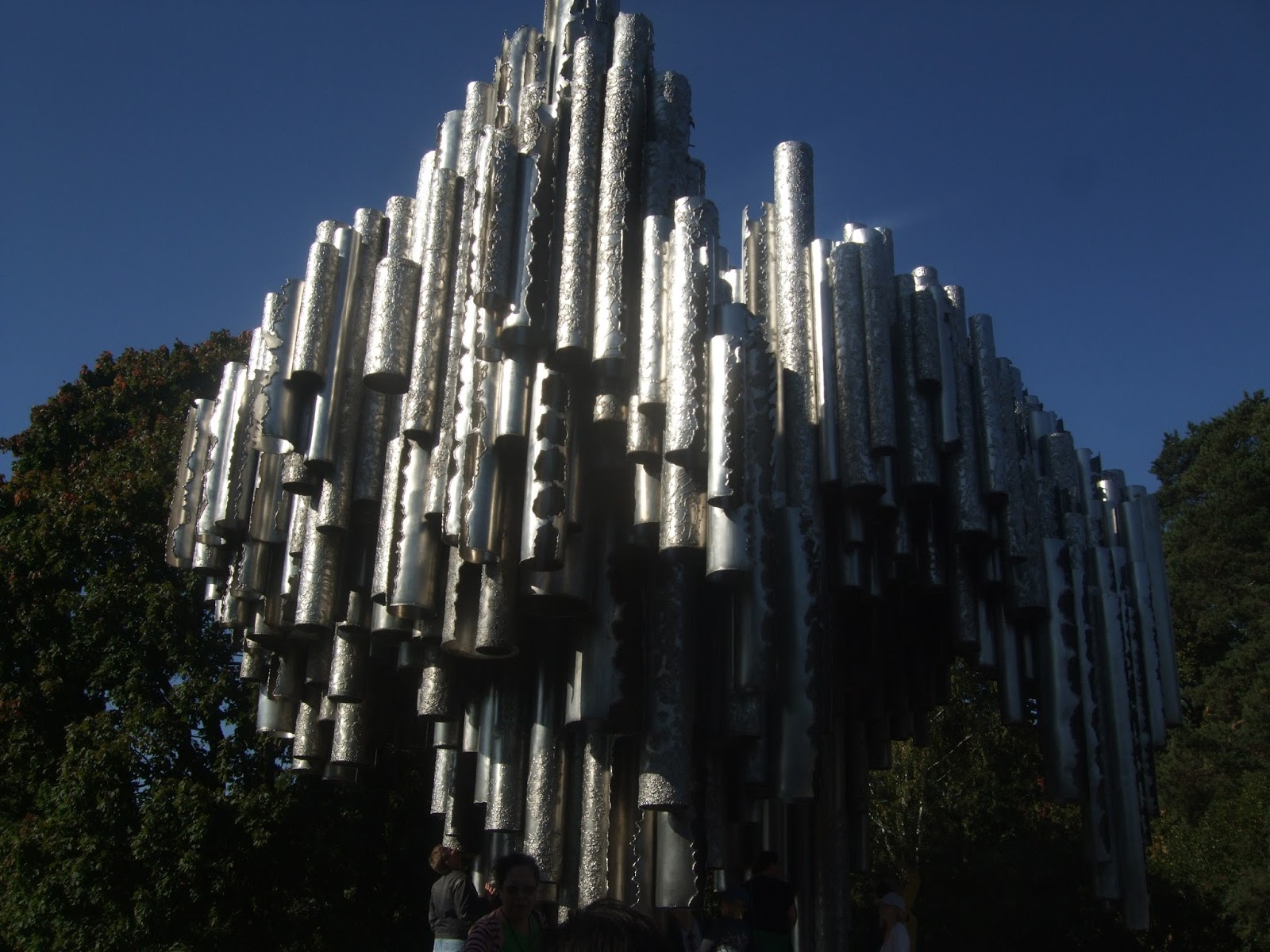
The next stop will be the Sibelius Park, where you have another mission: finding the Sibelius Monument, an impressive yet surrealistic piece of modern art, dedicated to Finnish musician and composer Jan Sibelius. 


   In Part 3, we will focus on museums: history and modernity, indoors and outdoors, near or far from the city center. Did I make you curious? Ok, this is what I wanted! So don't miss it! ;)
        

Saturday, 14 November 2015

Paris Terrorist Attacks: Who Is to Blame?


   We all know what happened last night in Paris, and we are all under shock. Less than a year later, what happened at the Charlie Hebdo headquarters proved itself to be just an introduction to a violent episode of a much larger scale, with a much bigger number of victims. I couldn't help but remember episodes such as September 11th 2001 in New York, the train bombings of Madrid in 2004, or the underground bombings in London in 2005. And it makes me wonder... why are some countries more exposed, or more targetted than others? 
     Amongst several comments, I read somewhere something along the lines of: "So, you wanted integration of immigrants? There you go, now have it!" Which, taken as a concept in itself, I deem totally unfair. We live in a globalized world, whether we like it or not. People move to different countries from their country of birth on a daily basis and in all directions. Multicultural environments are becoming more and more the norm, rather than exceptions. Heck, I've been an immigrant myself, and I met many other very peaceful immigrants. 
     Are certain religions causing more evil than others? Well, given the fact that many mass murders took place on non-religious bases, I wouldn't bet all my money on it.  However, it is religious fanatism that is harmful. Yes, muslims stand out more than other religions, especially because of the past episodes of terrorism which I mentioned before, be they claimed by Al-Qaeda or ISIS. However, I also have many muslim friends and aquaintances whose moral quality cannot be denied. 
      What should be done, in your opinion? A more strict control of immigrant inflows, possibly over an extended time frame? Undercover control of immigrant communities? How should we separate the good from the evil, in order to protect our own countries, but also to make sure nobody gets unfairly labelled or discriminated? 
       One of those posts which has more questions than answers. But I do need your opinions. May the victims of this attack rest in peace, as well as the victims of other similar episodes of violence around the world, and let's just take some time to reflect on what could be done in order for these things not to happen again. 
     

Wednesday, 7 January 2015

In Theory, Religion Counts as Culture. Then, why Kill in the Name of It?


   Unfortunately, the year 2015 on Culture Coffee Break will start with a controversial matter, and an event we wish never had happened. Today, the whole world has been shocked by the terrorist attack on the headquarters of the Charlie Hebdo weekly satire magazine in Paris. Twelve people, mainly staff members of the magazine, including famous caricaturists,  have been shot dead by Islamic extremists. Charlie Hebdo was famous for its controversial satires, and it was not the first time the materials it published created controversies, or received threats by extremists. This time, unfortunately, the threats became reality. 
     During my university studies of intercultural communication, an emphasis has often been placed on the inter-religious aspect as well. In other words, religion counts as culture, apparently. It counts, or should count, as tradition and ritual. It is the set of habits of each nation, ethnic group, and even individual, used to praise the divine force. The religions of the world are diverse, and with their own separate history and geographic location. However, just like nations, religions inevitably interact as well. At the end of the day, adhering to a particular religion and its practices, or even choosing to believe in a supreme spiritual power at all, should be a personal choice of each one of us, and acceptance and tollerance should be practiced. In an ideal world, that is. If you think in a different way, please don't shoot! ;)
       I never understood any extremist or even radical behaviour in the name of religion, whichever that religion may be. In theory, no religion in the world promotes violence, and all religions preach peace and love. I don't even agree with trying to convince or impose upon another individual your own beliefs. Like that excessively-religious relative who gets scandalized because you're not a church-goer. 
        However, what about the freedom of speech? Yes, it is one of the main values of the modern western world, but obviously not everyone seems to think this way. Do you think that the media should avoid tackling sensitive topics, especially on a humorous or sarcastic note? Everything is like a vicious circle, and if things continue this way, the future will keep seeing people and groups provoking each other, and violence continuing. Nothing justifies killing in the name of religion, and these people must be condemned, but neither was it worth for the journalists and humourists to risk their lives over it. Do you think there is a way to prevent these tragedies from happening again? What will be the future of Charlie Hebdo?
        This day will not, and must not be easily forgotten. My thoughts are with the victims of the Charlie Hebdo attack and their families, in the hope of peaceful co-existence between nations and religions.