Showing posts with label Cuisine. Show all posts

Saturday, 3 November 2018

The Romanian Traveler: Cluj-Napoca, Straight to the Heart of Transylvania (Part 1)


      Here we are again, continuing to discover Romania, and this time, I will take you to the country's most famous historical region, Transylvania, and its most important city, Cluj-Napoca. And, I should add, probably the most praised Romanian city. Because every single person who has visited it has remained very impressed. Yes, even more than Bucharest! But why is that? I must admit, this was not my first time in Cluj, but it was the first time that I actually had the time to visit the city more thoroughly. Therefore, the previous times did not leave me with much of an impression, neither good nor bad. 
        First and foremost, we must specify that Transylvania is known by everyone (Romanians and foreigners), as "another Romania", compared to the southern part of the country. Not only because the influences of the Austro-Hungarian Empire are still felt from the architectural, urbanistic and linguistic points of view. But also because of the notably higher level of civilization, lower level of chaos, and very calm people. 

The city


    The general impression when you arrive in Cluj (after a 10 hour ride from Bucharest, that is if you don't take the plane), is that you find yourself in another historical period, such as the beginning of the 20th century. 


Beautiful buildings from centuries past, which have been only reconditionned during the last few years, since Cluj had been elected European Youth Capital 2015. Clean streets, and a level of traffic which is hardly as scary as the one in Bucharest. :)


     Two main squares, are reigning on the city: two historical figures and two religious cults. One is Piata Unirii (Unity Square), with St. Michael Roman-Catholic Cathedral and the statue of medieval monarch Mathias Corvinus. The other one, after a 10 minute walk in a straight line, is the Avram Iancu Square, dedicated to one of the most prominent revolutionary personalities of 1848. His monument lies in front of the Orthodox Metropolitan Cathedral, and accross the way from the "Lucian Blaga" Theatre and Opera House, which is another elegant building which doesn't go unnoticed. 


The people

      Transylvanians are known to be the calmest (and slowest) Romanians, and many jokes have been told on this topic accross the ages. However, I did appreciate their calm nature and their politeness. When you come from Bucharest, it's like a breath of fresh air.
     Otherwise, Cluj is a very youthful city, as it is an important university center, the Babes-Bolyai University, and the University of Medicine and Pharmacy are among the most prestigious in Romania. Therefore, Romanian and international students can be seen all over the city.
    Last but not least, as I mentionned before, Transylvania used to be a part of the Austro-Hungarian Empire. Consequently, Hungarian and German minorities are very well represented (in Cluj, the most numerous minority is the Hungarian one). You will hear on the streets people speak Romanian, Hungarian, and sometimes even a mix of both. 


The food

    This is another element that got me impressed. I found the food to be very good and very convenient, and with a broad range of dishes to choose from. 
    The most famous local dish is 'varza (cabbage) a la Cluj', which consists of minced cabbage on a bed of minced meat. It can be served with sour cream and chilli pepper, upon request. No big deal, come to think of it, but very consistent and delicious. The best place to eat it is the Varzarie, a traditional restaurant in the city center, which, as the name suggests, serves mainly cabbage dishes, but not only.


     Another restaurant which I absolutely loved is called Opera, and is located, again, as the name suggests, close to the Opera House. Decorated in a vintage art nouveau style, it is a self service restaurant, with lots of dishes to choose from: my advice is to try the stuffed aubergines (with mushrooms and grated cheese), spinach pancakes, or meatballs soup. 
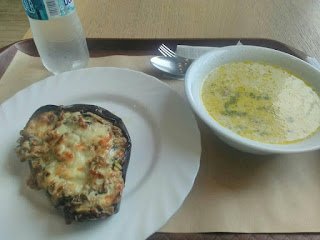


     Otherwise, Cluj is also full of cafes and bistros, still keeping the atmosphere of other times, which gives a different flavour to whatever you eat or drink.


       In the second part of our journey through Cluj, we will take a look at the places to see. Although, I must admit that I had a bit of an unpleasant surprise, but with good results in the long run. Wonder what that is...? 

Monday, 26 March 2018

Romanian Holiday Spirit: what You Should Expect if You Spend Easter in Romania


  Easter is coming. Although judging by looking out of the window and contemplating the (still) snowy landscape , we would rather think that Easter and Christmas have swapped places this year. But, it's the truth: on the 8th of April, we are celebrating Easter. Please note that, although Romanians  celebrate Christmas on the 25th of December, we celebrate Easter on the old Orthodox calendar, which in some years coincides with the non-Orthodox world, but most often it doesn't. 

         So, we have less than two weeks to go, and I'm inviting you to spend Easter in Romania. What is happening exactly?

The Church Service

Compared to Christmas, Easter has a higher degree of religious solemnity about it. Because the most important moment is the Resurrection sermon, held at night between Saturday and Sunday. So, we go to church at night, and the service is held outside the church, in the open air. At midnight, when it is said that Christ has resurrected, the priest spreads the holy light (which arrives every year from Israel), by lighting the candles of some participants at the ceremony, which, in turn, light each other's candles. After the service is over, we are all heading home with the lit candles, and we have to make sure they stay lit until we get home.


Now, you know me: I'm not the most religious person you'll meet in your life, but this is one of the few occasions when I want to go to church. Because it gives a special feeling, which one can understand just by being there. Plus, it is also a socializing event: it's impossible not to bump into relatives, neighbours, aquaintances, and even start talking to new people. 


The Food

So, after we get back home at night, what do we do? Of course, you guessed: eat! And yes, also at night, not just on the Easter Sunday lunch time. 

What is indispensable from the Easter feast?

- coloured eggs: 

There is special egg paint, in which eggs must be boiled so that the egg shell changes colour. They should be mainly red (symoblizing the blood of Christ), but you can make as many colours as you like. Plus, in some parts of the country, or the country side, or people who have more patience and skill also make drawings on the egg shell.


- lamb dishes:

Lamb soup, roast lamb, drob (minced meat pudding, made with lamb organs), stufat (lamb stew made with spring onios and spring garlic). Not everyone likes lamb, and not everyone wants to eat lamb for emotional reasons, but I can't think of any traditional Easter dishes without lamb. 

- pasca:

Typical Easter dessert, a sweet cheese pie made with cream cheese, raisins and vanilla flavour.


The People

Easter, just like Christmas, is spent with family and close friends, visiting each other at Sunday lunch. People greet each other with the phrase 'Christos a înviat!' (Christ has resurrected) and the other person has to reply 'Adevărat a înviat!' (Truly He has resurrected). It is not a very 'music and party' atmosphere, but just an occasion to be together. 

So, in the end, what we hope now is that the weather will be on our side, at least a little. Because otherwise we'll find Santa Claus, and a pot of sarmale instead! Anyway, I will wish you Paște Fericit, because I like to believe that this is what is happening after all! ;)

Sunday, 19 November 2017

All Roads Lead to Rome... but Hurry Up!


    Exactly one week ago I set foot in the Eternal City, for the first time after 18 years. Yes, it's a lot of time, and it is something different to look at everything through the eyes of an adult, as opposed to the eyes of a teenager. However, it is mandatory to mention that I was there on business, so I didn't have much time to be a tourist, and feel the vibe and personality of each place, as I normally like.  And Rome has a lot to offer, from all points of view. My tourist activity this time was fast (but not furious :P), and unfortunately, rather superficial. Therefore, I will give you 15 pills about Rome, as basic departure points. 


1. Rome is really the Eternal City. Nowhere do you feel as connected to such a distant past, as you feel when you are around the Roman Forum, Traian's Column, or the Colosseum. In fact, the historical city of Rome is part of the UNESCO World Heritage.


2. Rome is a meeting point for everything that means history, art and architecture. And you see this wherever you look. 

3. The city is very chaotic and very populated. It will not let you sleepwalk and relax while you visit, so you will feel the need to be in continuous movement yourself. 

4. Distances between one place and another are pretty long, even within the city center, and quite often the quality of the roads leave a lot to be desired. So, it's best to move around in metro.

5. If time is not on your side, try moving around in a hop on/ hop off tourist bus. You will get an overview of Rome's attractions.

6. Rome is mostly associated with scooters as a means of transportation. Think Audrey Hepburn and Gregory Peck in 'Roman Holiday'


7. You will see lots of funny trees on the roads around the city, and you may not have seen them anywhere in the world. Well, my dears, they are called domestic pines.


8. Few monuments are as somptuous as the Altare Della Patria, of Piazza Venezia, built in honour of King Vittorio Emanuele II.


9. The shores of river Tevere, with the view on St. Peter's Basilica or Castel St. Angelo, in autumn colours and under the rain, have something undeniably picturesque.

10. For Vatican visits you need an entire day, but it's absolutely worth it, whether you are religious or not. In fact, this small state within a state constitutes another UNESCO World Heritage associated with the Italian capital. This time, for me it was out of the question to make it, but I would still love to admire Michelangelo's Sistine Chapel and have a word with St. Peter one more time. ;)

11. Rome is also the home of Italian cinema, testified by the Cinecitta' studios. One of my other regrets is not having yet visited them, not even as a kid.

12. Romans are loud and chatty, but also very friendly. Plus, for some mysterious reason, in Rome selfies don't come out as nice as photos being taken by someone else. Which means that Rome must be enjoyed in company. So, travel with a friend or talk to the people around, and have your photo taken. 

13. The Trevi Fountain smells fresh and the water is clean. Don't forget to throw a coin in the water, in order to make sure you return to Rome, as the legend says.


14. One local dish that you must absolutely try is pasta cacio e pepe, which literally means cheese and pepper. Soothing and a little spicy at the same time. Actually, I tried a little variation: cacio e pepe lasagna with artichokes. :D


15. Last but not least, now that you just ate, there is a way to get rid of the extra calories without going to the gym. Climb the stairs of Piazza di Spagna! You'll be almost dead afterwards but it works. :P


    In conclusion, to visit Rome in depth, seeing everything that needs to be seen and without feeling like you're running a marathon, you would probably need 4-5 days. Therefore, this fast and brief visit obligated me to a sequel. But I promise that this sequel will be slow, and I will tell you much more about the Eternal City. Until then, as an old song said... arrivederci Roma!

Sunday, 1 October 2017

Helsinki: the City where You Recharge Your Batteries (Part 1)


   Have you ever been to Finland? Or at least to Helsinki? If you haven't, the first thing you should know is that, although it's not your usual mainstream destination, like Paris, London, or Rome, the Finnish capital surely has its own charm. And yes, there is more to it than saunas and freezing temperatures. We won't count Santa Claus and his reindeer, as we are not in Lapland this time. :) The second thing you should know, as I decided to point it out in the title, is that I surely recommend it if you are after relaxation and recharging your batteries, but probably not as much if you are after high adrenaline and looking to party hard.


      Helsinki is a city that is not overpopulated  or suffocated by traffic. It is safe, with wide and clean roads, close to nature (parks, forests, lakes, sea), showing impressive architecture both in classic and modern styles. As a matter of fact, Finland is very resourceful when it comes to modern and contemporary design. 


     Culturally and historically speaking, Finland is a complex nation. From the Middle Ages, it became and integral part of Sweden following crusades, and later became a part of the Russian Empire at the beginning of the XIXth century. In the end, it became an independent state after the Russian Revolution, in 1917. Therefore, Finland is geographically located between Scandinavian countries and Russia, but its language is of the Uralic family. And surrealistic, if you ask me. :) Expect long words, double vowels and consonants, umlauts, and basically a language that bears no similarity to others (apart from Estonian, as far as I know). Did you know that 'terve' means 'hello', 'hyvaa' means 'fine', and 'kiitos' means 'thanks'? Oh, and 'please' doesn't exist. Plus, Swedish is an official language also in Finland, so expect all signs in all public places to be written also in Swedish. 
          What about the people? Finns are mostly blonde, with fair skin, and light-coloured eyes. They may not be as bubbly as the Italians or the Spanish (or the Romanians on a good day :P ), but nevertheless they don't lack friendliness, and surely are very polite, helpful and correct. And what impressed me especially is the way people help and support each other in neighbourhoods and small communities, be it with babysitting or any other chores. In my opinion, an evolved nation is one where people trust and help each other. Dear Finland, you'd have a lot to teach Romania! 
            Before we start exploring the city in part 2, I will invite you to dinner. Finnish dinner, that is. 


You will be on a fish diet. You will eat fish every day, especially salmon, but not only. It can be salmon soup (for colder days), but also fish or seafood salads, or fish with potatoes, mushrooms of all kinds, and horseradish. I was also told that reindeer steak is very good, but I didn't want to try it. As I've always been against hunting, I would have felt bad. What will Santa drive afterwards? Poor Rudolph & company! :'( Another interesting dish that I liked is the rice pie: a thin pastry filled with tasty rice, and topped with egg paste.


 For dessert, they have lots of scrumptious looking cakes, with cream, chocolate, caramel, and not only. Coffee is also very good and of several kinds. And for chocolate lovers, I highly-highly recommend to try the national Finnish brand of chocoalte, Fazer. They have loads of types of chocolate, with all the possible flavours, and I was also told that they are constantly inventing new stuff. ;)
             Speaking of food, you will also discover that Finns have their meals much earlier than 'continental' countries. They start work at 7 or 8 in the morning, which leads them to have breakfast at about 6 a.m., lunch at about 11, and dinner around 5 p.m. The early bird catches the: a) salmon; b) reindeer; c) Fazer! :D
           In part 2, we will proceed to discover the city and what I definitely advise you to visit. I didn't manage to see exactly everything I planned, but I already saw about 85-90%. And who knows... I might return someday. I surely would not mind! ;)


Wednesday, 30 November 2016

Athens & Piraeus: Stories of Vibes and Atmosphere


    We surely need a separate post to capture the vibe of Athens, beyond the main tourist attractions. And I must confess that you will not often see a city so crowded, even unexpectedly cosmopolitan, with people of all social conditions. Yet, this crowd, surprisingly, is not disturbing at all. Also, like all capital cities, Athens is full of life at all hours. The streets are full of olive and orange trees, as well as coloured flowers, still there in the month of November. Cafes, markets, shops and restaurants can be found all over the place, and the only dilemma you will have is where to go first. 


       If, like myself, you are going there for a few days as a fully-immersed tourist, I would advise you to buy a 2 days' pass on a hop on & hop off tourist bus, such as Athens Open Tour. A 2 days pass, bought online, cost 18 euro per person, so watch out for such special offers. The advantage is that it stops at all points of interest in the city, and you can get on and get off how many times you want, watching out for all the stopovers on the map. With the headphones offered as you get on, you can listen to the description of all the places you pass, in several languages. Speaking of which... yes, Greek looks and sounds like an impossible language, especially because of the alphabet. However, just have a go at learning some phrases, at least for fun, and to use them to find your way around. And who knows, you might even like it! :)


     When you are in between archeological sites and museums, you should definitely not miss Plaka, which is one of the most ancient areas of Athens, starting from Acropolis, and ending around Monastiraki Square. Plaka is made up of pretty and narrow streets, small buildings in typical Greek architecture, with white marble and iron decorations, with all the characteristic vegetation and lively colours.
      Explore the numerous shops all the way to Monastiraki Square, also one of the most important squares in the city, especially for shopping, where you can find everything you want: ceramic and clay objects, paintings and drawings, typical Greek sweets, clothes and jewels with traditional motifs, coloured leather bags, cosmetics based on olive oil and donkey milk, and the list could go on and on. Greeks like to negotiate, so definitely expect that when you go shopping. You won't buy anything (or almost) at the price displayed on the label. 


       Also, if you go to Monastiraki on a Sunday, be prepared to see the biggest crowd you will ever see, from the strays and homeless of the city, to rich and elegant people, locals and tourists, who enjoy a day out. 


       As you reach lunch or dinner time, which I'm sure you will, the Monastiraki area (and not only) will offer you a wide choice of places to eat. Obviously, Greece is famous for its cuisine, so I wouldn't even recommend that you eat somewhere else than traditional Greek restaurants and taverns. The choice of dishes is, again, very broad. But by no means should you miss moussaka, a dish based on minced meat, layered with sliced aubergines and potatoes, and topped with white sauce. Not particularly light, but delicious. :) Greek cuisine also includes souvlaki (meat skewers), traditional salad with tomatoes, cucumbers, peppers, olives and feta cheese, large seafood plates to share, and pastries of various types. Also keep an eye on traditional Greek yogurt (which is different from what you find in supermarkets in the rest of Europe), and for the best olives (both black and green) that you will ever eat.


     Last but not least, as you might remember, I promised you a bonus trip. This is the neighbouring town of Piraeus, Greece's most important and ancient harbour. And actually, the tourist buses which I was telling you about also offer an itinerary towards Piraeus, so it would be a pity to miss it. Still with a very strong 'Greek' atmosphere, Piraeus is also cleaner and less crowded than Athens, and, at least on the first glance, more exclusively higher class. A relaxing town by the sea, where it will be a pleasure to sip your coffee by the shore, and last but not least, you will be left wanting an apartment and a yacht right there and then. :)


      My conclusion about Athens is that it is indeed a city where history and ancient civilizations meet a dynamic world, with vibrant colours, exquisite taste, and people permanently in motion. It was a perfect birthday present, and I am looking forward to going back someday. 
          ευχαριστώ, Αθήνα! I will not stay away too long!