Showing posts with label Events. Show all posts

Saturday, 1 December 2018

Romania Is Inviting You to Her 100th Birthday Party. Please Study the Gift List!


      Imagine you have a Grandma whom you love to bits, but sometimes she's getting on your nerves, so much that you want to leave home. Because she is doing things that completely lack in logic, and making your life hard, while finding your way around, even in the smallest everyday matters. Those of you who may have had a problematic grandparent surely understand the analogy. And now, guess what? Your precious Granny is turning 100 years old, as the 1st of December marks the Great Unity of 1918, the day when we became one big country. So, you decide to buy her some gifts she could use in order to make her life (and yours) easier. 
      These days are difficult though, and so have been the last two years. Bad governance, tensions, protests, and consequently people getting more and more nervous and unsatisfied about life in Romania. Sometimes we got the feeling that all the political tensions had the (good) side effect of uniting the people, but this feeling is rather short lived, or comes occasionally in hot spurs, and then we go cold-turkey on each other again.

                                    
      What do we want, in order to stop feeling so fed up with everything? What presents could good-old Romania use at the venerable age of 100 years old?
     1. Leaders who (at least) try ruling the country considering people's needs, not only their own advantages and bank accounts. 
     2. More schools and hospitals, and better conditions in the already existing ones, and less churches and cathedrals, because we already have enough of these. And that mammoth cathedral in the center of Bucharest...just don't ask!
     3. And if it really has to be churches, may the Church get more involved in helping those in need. I know that some priests do get involved, but some others just glitter...on the surface. 
      4. Decent salaries and pensions, for everyone to be able to support themselves. It's heartbreaking to see some people beg in the street, whilst some politicians have so much money that they could feed a small town each.
      5. Good roads and infrastructure. Highways. And most of all, people who drive carefully. 
       6. People who respect each other, who use common sense and common courtesy and can lift a hand to help others if necessary. People who are also givers, not just getters.
     7. Care for the environment, be it in the middle of nature or on the cities' streets, as it is already suffering. 
    8. Restructuring roads and buildings. We have jewels of architecture, which unfortunately give the impression that as soon as you touch them with a finger, they are going to crumble.
    9. People who are learners and doers, permanently evolving, without complacency and ignorance, and without expecting exclusively solutions from 'above'.
         10. People who end up in high positions because they deserve it. 'Nuff said!
          11. Obtaining basic administrative documents with ease, and without complicated bureaucratic practices. 'Nuff said part 2!
         12. Last but not least... love. People (with and without power) who love her, each other and life in this country!
          I wanted to make a list of 100 presents, but in the end I kept it simple and realistic. And in my opinion, what I wrote here is not exactly 'the sun, moon and stars', although for us this stuff sometimes feels just as unattainable as pink unicorns. For other countries, they are just normal. Why shouldn't it be like this for us too?
        As for me, I am realistic enough and I have lived abroad long enough to know that no place on this Earth is perfect. Nor do I fancy myself as some amateur political analyst who tries to interpret why some things are happening and predict what is going to happen in the future, engaging in some over-drammatic speculations, and seeing only the negative in all situations. I am just analyzing what is working and what's not, from the simple perspective of everyday life, independently from political orientation. I know that I don't like what is happening now, I know what changes I'd like to see, but I am also aware that it's highly up to ourselves as well. Oh, yeah, and that includes going to vote when elections are on! Don't say that the country is sh*tty, because you are part of it too, and besides, it's the people who create society, be it made of sh*t or creme brulee'! :P
     Nevertehelss, I am happy to be here and to be alive on this day. After all, it is 100 years old. The roundest number ever! And I bet 100% that I won't be around to see the 200th anniversary. So, why not enjoy it and be grateful?! Romania may not be world's most evoluted country, but let's keep in mind that we had it many times worse in the past.
     La multi ani, Romania mea!
      

Thursday, 30 November 2017

If Romania Asked for Birthday Presents, what Would They Be?


    Imagine you have a Grandma who you love to bits, but sometimes she's getting on your nerves, so much that you want to leave home. Because she is doing things that completely lack in logic, and making your life hard, while finding your way around, even in the smallest everyday matters. Those of you who may have had a problematic grandparent surely understand the analogy. And now, guess what? Your precious Granny is turning 99 years old. One year from now,  she will be 100. You know she's not going anywhere because she is immortal. So, you decide to buy her some gifts she could use in order to make her life (and yours) easier.
      Yes, Romania is 99 today, as the 1st of December marks the Great Unity of 1918, the day when we became one big country. 
      These days are difficult though, and so has been the entire year. Bad governance, tensions, protests, and consequently people getting more and more nervous and unsatisfied about life in Romania. Sometimes we got the feeling that all the political tensions had the (good) side effect of uniting the people, but this feeling was rather short lived, or comes occasionally in hot spurs, and then we go cold-turkey on each other again.

                                    
      What do we want, in order to stop feeling so fed up with everything? What presents could good-old Romania use before she turns 100?
     1. Leaders who (at least) try ruling the country considering people's needs, not only their own advantages and bank accounts. 
     2. More schools and hospitals, and better conditions in the already existing ones, and less churches and cathedrals, because we already have enough of these.
     3. And if it really has to be churches, may the Church get more involved in helping those in need. I know that some priests do get involved, but some others just glitter...on the surface. 
      4. Decent salaries and pensions, for everyone to be able to support themselves. It's heartbreaking to see some people beg in the street, whilst some politicians have so much money that they could feed a small town each.
      5. Good roads and infrastructure. Highways. And most of all, people who drive carefully. 
       6. People who respect each other, who use common sense and common courtesy and can lift a hand to help others if necessary. People who are also givers, not just getters.
     7. Care for the environment, be it in the middle of nature or on the cities' streets, as it is already suffering. 
    8. Restructuring roads and buildings. We have jewels of architecture, which unfortunately give the impression that as soon as you touch them with a finger, they are going to crumble.
    9. People who are learners and doers, permanently evolving, without complacency and ignorance, and without expecting exclusively solutions from 'above'.
         10. People who end up in high positions because they deserve it. 'Nuff said!
          11. Obtaining basic administrative documents with ease, and without complicated bureaucratic practices. 'Nuff said part 2!
         12. Last but not least... love. People (with and without power) who love her, each other and life in this country!
          I wanted to make a list of 100 presents, but in the end I kept it simple and realistic. And in my opinion, what I wrote here is not exactly 'the sun, moon and stars', although for us this stuff sometimes feels just as unattainable as pink unicorns. For other countries, they are just normal. Why shouldn't it be like this for us too?
        I will update you again this time next year. But in the meantime, I will make also another commitment to you. Next year will be our Romanian year. And my commitment is that until the 1st of December next year I will give you 100 reasons to love Romania. 
          Are we celebrating or protesting? Both. Personally, I'll be working tomorrow, so I'm not attending anything. But in my heart, it's both. People I know will be demonstrating in town, and I salute them. 
          Happy Birthday, crazy old bat! And now go party hard, before your sarmale get cold! :P


Saturday, 24 September 2016

European Day of Languages: Learning and Fun in One Short Event


       In 2001, the European Commission has established the European Day of Languages to be celebrated on the 26th of September each year. And today I managed to attend this event in Bucharest for the first time, as for the past years I never seemed to make it, for one reason or another. 


          How was the event organized? In the yard of a famous Bucharest museum, several stands of the various European Cultural Institutes with a headquarter in our city, were waiting for their numerous visitors. The participating countries were: Germany, Turkey, Belgium, Great Britain, Portugal, Greece, Austria, France, Italy, Poland, Hungary, Romania, Czech Republic, Spain, and of course the Representation of the European Commission in Bucharest.
          Each of the presenting countries made guests complete a task. This could be a cultural quiz, to verify your general knowledge about a specific nation, guessing famous landmarks from pictures and placing them on the country's map, matching fragments of literary texts with titles of literary works, memorizing games based on factual information on a specific city, or matching the meaning of certain words between Romanian and the host country's language.


        What did I learn today?
         .... Germans are not a hard nation to figure out. I scored 6 out of 10 questions from the cultural quiz of the Goethe Institut. So far so good, given the fact that I just started learning their not-so-easy language!
    .... Turkey is an amazing country, with spectacular landmarks. I really wish them more peaceful times ahead, so that everyone can relax and enjoy this country's beauties.
         .... I still know my English children's literature pretty well. Not one single mistake! And the Earl Grey tea I was offered crowned (ha!) my success.
            .... Portugal is a country that I'd like to visit in the near future. And for my seaside holiday in Algarve (nothing more, nothing less) I will need: chinelos, guarda-sol, toalha da praia and fato de banho. All clear, right? :)
            ... Greeks are even easier to figure out. From their 10-question quiz, I only got 1 wrong. And I got myself a map of Greece, in honour of my next travel destination (hint, hint!) :)
            .... I was warned that the quiz about Paris was difficult. But I got it right from the first time. And surprise: my French was not as 'imparfaite' as I thought!
          .... thanks to the Istituto Italiano di Cultura and their landmarks pictures, I found out even how Caserta looks like (one city I knew almost nothing about, apart from the fact that it's in Campania). They organize free movie evenings once a week, and the guy hosting the stand was really nice and cool. And Sicilian. ;)
            .... Hungary is a paradise of thermal water spas. Which sounds interesting! Brochure: taken. Koszonom szepen!
          .... Czech and Romanian have several similar words. Only the spelling can be tricky. But, with a bit of Staropramen beer, you might even become fluent!
             .... Polish and Romanian instead are sharing some pairs of homonyms. That is, words spelled and pronounced the same way, but which have different meanings in each language. For example, Romanian word 'pas', meaning 'step', in Polish means 'belt'. Or 'obraz' means 'cheek' in Romanian, and 'picture' in Polish. Not to mention that I came with 2 big brochures about Polish cities and touristic attractions. Time to consider another trip! :)
              .... switching languages may not be as difficult as one might think, but you might need an extra bit of concentration. Today I spoke English, French, Italian and Spanish with the relevant stands in a matter of minutes. And it was not difficult at all. On the contrary: it was actually fun.
             EDL is one of those events which are both fun and educational, and it doesn't last too long to visit each stand. Therefore, it is easy to squeeze between other commitments during the day. My only advice is not to lose your patience with the other visitors, as it is a pretty crowded event, including also families with children. But this demonstrates that people are up for some higher-level activities, not just watching reality shows on TV. And this can only make me happy!


Monday, 30 May 2016

Indonesia: an Explosion of Colour and... Sweetness


       As my dream of travelling outside the old continent hasn't yet had the chance to come true (we could get into a debate about time and money, or a combination of the two, or about myself not being brave enough to travel alone as a girl and bla-bla-bla, but that is not the issue ;) ), as you may already know, whenever I have the occasion I attend cultural events from various countries which are, for the moment, unaccessible.
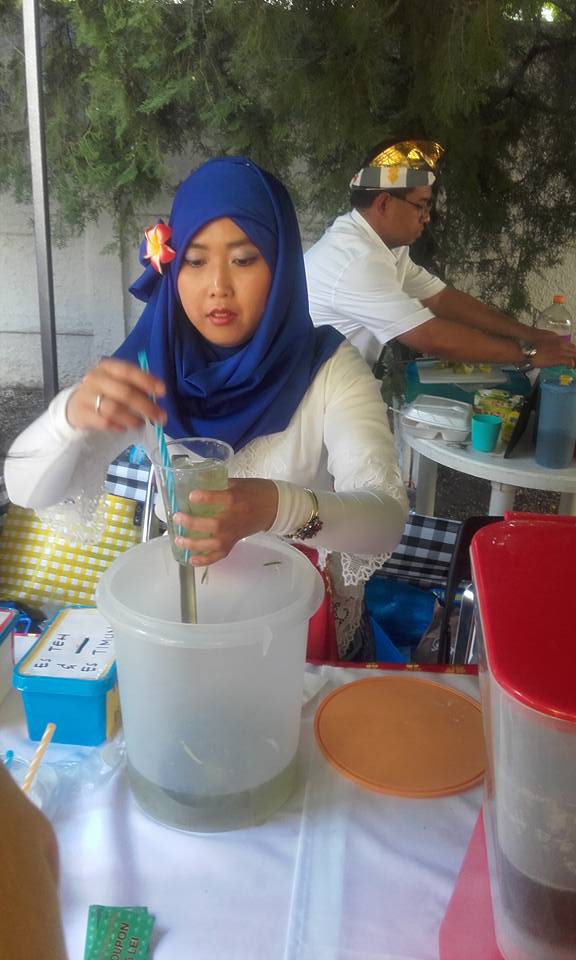
        Said and done: this week-end I popped by the Indonesian Embassy of Bucharest, where the event 'Piața Indonezia' (Indonesia Market) was taking place. It was a cultural event lasting a few hours, around lunchtime and early afternoon.
        Now, I admit that I didn't know much about Indonesia until the recent past. Well, apart from the fact that Bali is a very popular touristic destination. However, the company I work for has an office in Indonesia as well, and I got the chance to interact with colleagues from this country. And most surely, this played a major part in stirring my curiosity.


       The event itself, not being very long, contained short manifestations of various kinds, comprising different aspects of Indonesian culture. Traditional dances and music (and also pop music played by Indonesian musicians), martial arts demonstrations, clothes, handicrafts and souvenirs to buy, and, of course, local food and drinks. 
           What caught my attention especially has to do with the visual part, but also with... taste. And here are my first impressions as an outsider.
             First of all, Indonesia is about colour, flower patterns and gold. That can be noticed in their traditional costumes, and the ornaments and accessories. 


             Indonesia is also ... a friendly country. Or, so it seems, because of the politeness of the people I met, and who always wear a smile. Besides, the way they involved the public in a traditional dance says it all. Plus, let's not forget the statues, masks and mythological creatures which are amusing in themselves. 


              Last but not least, Indonesia is very sweet. On a very hot day like it was last Saturday, cooling off with a (sweet) cucumber punch, or a very fruity drink called Es Teler. The coconut pancakes which I had heard about and which I was really tempted by had finished before I arrived to the food court, but I still managed to buy some tourquoise sponge cake, also with coconut flavour (talk about colours and sweetness).
                 

                The event was interesting, but it was also brief... and overcrowded. The back yard of the Embassy was not that big. Maybe they didn't foresee such high presence, but, on the other hand this demonstrates that people are curious when it comes to culture. For next year, I hope to see more and taste more of Indonesia! 
             

Sunday, 10 April 2016

Is Your City Living Up to Its Full Potential?


     One of the major advantages of living in a capital city, or any major city, is that you keep discovering new things about it, even though you were actually born there. I have seen Bucharest going through a lot of positive transformations since the end of the communist regime to the present day. New buildings appearing in the landscape and old ones being restructured, modernization works, some of them even unnecessary, but that's another story. Would you believe that in 2007-2008 the historic center, nowadays so full of bars, caffees, restaurants and shops, and loved by tourists and locals spending their spare times, looked like World War II had just taken place? Well, I'm still astonished too.


            However, I recently discovered that what has been already done is far from enough. Bucharest has submitted its candidature as European Capital of Culture 2021. With this purpose, several cultural NGOs are regularly organizing pedestrian itineraries free of charge (or based only on donations from participants - you give if and as much as you want). These itineraries, which are very popular amongst the city's inhabitants, as tens or even hundreds of people attend every time, are meant to raise awareness to the undiscovered and/or forgotten parts of the city, hoping that the message would get to people in authority and something is done about them.


      I also attended this type of events a couple of times. And it's been insightful and saddening at the same time. Apart from the mainstream venues and touristic objectives, there are also many buildings, or even entire neighbourhoods, true jewels of architecture, which seem to be abandoned, perhaps claimed by some (real or fake) owner from the post-communist era, and left to deteriorate. Or neighbourhoods full of stories and legends from times past, which are now only inhabited by poverty and social cases. Or, a huge inhabited land by a lake generated a proper natural reservation, which is almost competing with the Danube Delta. Or, an amphitheatre which had started being built during the communist days with the idea of becoming a summer theatre is now abandoned and useless (well, I know communism has done lots of injustice to the population, but a summer theatre would do us good, as we like to have a rich cultural life in all seasons).
                   

          Bucharest has grown, but it can grow even more. I don't know if these things happen in all cities. I don't even know if action will be taken, or at least anytime soon. And I'm not that rich to become a top-notch land developper, 'cause otherwise I would. :) But one thing is certain: we cannot afford to lose such beauties, which can make our city an even more charming place. 
               

Saturday, 26 September 2015

The Truth about Life in Romania: the Romanian Social Butterfly


    I promised I would tell you small bits and pieces about life in Romania, and here comes the first installment, which, I should mention, applies more to life in Bucharest and major cities. Being in the first part of autumn, good weather is slowly starting to leave us. But during spring, summer and the first part of autumn, Bucharest vibrates with social life and events of all kinds, especially in the open air. Concerts, theatre festivals in the streets, international manifestations, exhibitions, organized city exploration, and so-so much more. During the warmer time of year, it is impossible not to find something to do, or some event to attend, by day or by night. And all these events generate huge crowds, because most of them tend to be free of charge. 
                             
       And here comes the first Romanian specimen we'll talk about, and which I admit I often identify with: the social butterfly. If free time is not a problem, or at least during weekends, Romanians like to put their gladrags on, take their friends, significant other or family members, and go out. People of all ages: from families with kids and even pets, to groups of youngsters, to senior citizens. For us, it's a method to relax, learn new things, and spend some time in the open with our dear ones. We don't have to spend a fortune if we don't want. It's simply about going outside and enjoying the city. Sometimes I feel there is a deep desire for beauty, in the middle of a pretty stressful everyday life. Like a small oasis of joy. After all, why shouldn't we break away from the TV and the gloomy news we are being given every day? ;) 


     But mind you: we usually tend to go out accompanied by our own circles of close people. Therefore, it happens very rarely to go out by yourself with the purpose of making new friends. See the difference? We shall talk at a later date about Romanians and friendship. But for the time being, keep in mind that if you want to visit Romania, and especially Bucharest, there is plenty to be seen, apart from the traditional touristic attraction. In fact, the pictures I have chosen are from three events that I recently attended:  an exploration itinerary in the old city with its architecture, an artisanal artefacts fair, and last autumn's 555th anniversary of Bucharest, which included lots of fairs and artistic performances.      Sometimes, you won't know what to choose between the various cultural manifestations. You will never get bored! 

Saturday, 20 June 2015

Traditional Culture vs. Modern Culture: Which One Do You Mostly Identify with?


        I love the fact that my city is having an increasing openness to other cultures, and especially now, as summer has arrived, a broad range of events from various countries are available to the wide public. Every year I attend the Night of the Cultural Institutes, when several European countries put their cultural heritage and their creativity into play, by organizing representative cultural events throughout the entire evening. 
           

      Last year we spoke about the challenges of making such an event attractive, and this year there was something else which caught my attention. Each of these institutes is doing their best in order to offer variety. However, for each segment of the public, some of these diverse events will be undoubtedly more interesting than others. Something that I notice is the fact that in many cases traditional culture (handmade artefacts, flokloric music and dance performances, traditional cuisine) is presented alternatively with modern culture (graphic design, animation, alternative music, modern cinema). The former represent a very "colourful" part of a nation's culture, the point of curiosity for most foreigners, but may not be seen as representative of everyday life, just like people don't normally dress in traditional costumes. On the other hand, the latter would only be addressed to a niche audience, and perhaps not everyone would enjoy it. 
           

         Tradition represents the basic part of any culture, and if we're interested in learning about other countries, that is where we should start from. Besides, that could even be combined with something useful in everyday life, such as trying some beginner language workshops, or learning to cook some national dishes. And afterwards, one could move to bigger "missions", traditional or modern, depending on personal taste and interests. Last night, my attention was mainly caught by Turkish and Hungarian art, Austrian and British sweets, but also contemporary theatre performances at the French and Hungarian institutes. Other than that, there have been many more manifestations to choose from.
         

        The final point is that all cultures offer a mix of old and new, and most surely everyone would find something interesting for themselves. But none of these parts should be neglected. If you were to organize such an event dedicated to the culture of your own country, region, or city, what would you do? Which part of your culture do you feel is most representative, and worth identifying with?

Thursday, 21 May 2015

World Day for Cultural Diversity: what Does It Mean for Us?


   Today we celebrate the World Day for Cultural Diversity. "Cultural diversity" is a term which has become a part of our daily lives only during the past decade or two, although some countries started facing it a longer time ago. Although it is celebrated one day a year, I cannot help but wonder: isn't this social phenomenon actually becoming the norm, rather than a peculiarity?
        Having lived in and visited various European countries, I dare say that "monocultural" societies have disappeared almost completely. If in the past the most common aspect of cultural diversity countries had to show for was the existence of ethnic minorities and regional differences, now everything is increasing with every single year. There are countries with a longer tradition, such as the United Kingdom, where cultural diversity has started to become an issue since the first part of the 20th century, thanks to the populations of the former colonies, such as India, Hong Kong, or the Carribbean, who have emigrated to the UK, gradually creating what is now known as one of the most multicultural societies in Europe, and where each of these cultures have made room for their own identities and traditions, mixing with the local ones into a colourful mosaic. 
          On the other hand, there are countries like Romania, or the other former communist countries, which have started to experience cultural diversity on their own territory only in the recent years. Until recently, Romania was a rather monocultural country, with the exceptions of ethnic minorities in various regions of the country: Hungarian, German, Serbian, Turkish, and others. Lately, though, our country has started to stir the interest of foreigners from several parts of the world - merchants, investors, cultural operators, high-skilled workers. Furthermore, I noticed an increasing curiosity of the Romanian population towards "otherness" and the cultural practices of different countries. Several countries have their own cultural institutes organizing events and language courses, the center of Bucharest is full of restaurants and bars with international specific, there is a Chinese community with their own shopping center in a populated area of the city, Indian and South-American artefacts shops, and so much more. Not to mention the cities which took part in European programmes meant to promote cultural diversity, such as Sibiu (European Capital of Culture 2007) and Cluj-Napoca (European Youth Capital 2015). We may not be a very culturally-diverse society, compared to other countries, but we are definitely on the right track. 
      What should cultural diversity mean to each one of us? Acceptance, tollerance, curiosity, knowledge, exchange. No nation will live its future in a crystal ball, and cultural interaction will become more and more evident in the future, either because we get to travel more often than in the past, either because this cultural diversity will start happening around us, maybe even in our own neighbourhoods. The key to making it an enjoyable experience is to be open to learn about the other, but also to share about ourselves. Let's embrace cultural diversity - today and every day! 
             

Sunday, 12 October 2014

Asia Fest 2014 - a Cultural Slice of Each Asian Country

    
 I am very proud to discover that my city and my people are becoming increasingly curious to discover other cultures. And the Asian continent is not characterized by physical proximity, and substantial resources are required in order to get there. Therefore, if the average Romanian citizen cannot afford to visit Asia, Asia is visiting us.
     

     As a matter of fact, in these days Bucharest is hosting its second edition of Asia Fest. In five days, we get to discover a little bit of... Japan, China, Korea, India, Sri Lanka, and (partially European) Turkey. Just like for any event that involves the participation of several countries, each of these countries has to put its best foot forward, through their most interesting cultural practices. 
    

    So, what could visitors entertain themselves with?
    ... workshops in Chinese, Japanese and Korean caligraphy
    ... Japanese costumes workshop
    ... Indian henna tattoos
    ... Ikebana worksops
    ... painting on water
    ... Korean tea ceremony
    ... music and dance shows from each country
    ... parade of national costumes
    ... sculpture in fruits and vegetables
    ... Origami workshop
    ... Manga drawing
    ... movie projections 
  ... and of course, loads of food - Chinese, Japanese (Sushi), Korean, Turkish and Indian. Some of them were even prepared on the spot.
           

         And the list could go on. I am sure I have missed several activities, but with one activity more interesting than the other, variety was the defining word for the event. And the setting was so full, that it was hard to find your way amongst the visitors. It is hard to be present during all the activities in these kinds of festivals. More likely, I believe that they also serve in stirring curiosity among people, if there is a particular culture, or language, or  topic, or artistic practice, that they wish to learn more in depth. And after all, the cultural institutes of the respective countries are always active and available for various initiatives of this kind. So, whoever wants to learn more, they have the chance. 
        

       As for me, I councluded the evening with a Sushi dinner (one of my favourite foods), which I also saw being prepared in front of me, and... I signed up for a 10% discount voucher on any trip to Asia, if taken before October 2015. If I am lucky with time and money... I will certainly be looking forward to that. ;) 


Wednesday, 24 September 2014

555 Years of Bucharest.... and Why I Think My City Has a Complex Identity


   A celebration lasting all year culminated last week-end. On the 20th of September, Bucharest, the capital city of Romania, as well as my hometown, celebrated 555 years since it was first attested in an official document. This year was full of cultural events of all types in our city, all matching, from one point of view or another, with the cultural identity of Bucharest and its inhabitants throughout the years.
  

  Apart from becoming overly sentimental, like many of my fellow citizens of Bucharest, I started to think about what makes my city special. And there are so many contrasting features! Being multi-faceted is surely a characteristic of all capital cities, but the features in themselves, and the combination of them, are unique for each city.


    When visiting Bucharest, most foreigners tell me that it is full of contrasts, and some of them rather painful. Our population typologies range from the hot-shot rich guy with a BMW and a luxury villa in one of the selected neighbourhoods, to the homeless beggar. Unfortunately, social equality is a distant dream for us. Our architectural landscape varies from the elegance of the interbellic era, which earned Bucharest the name of Little Paris, and whose atmosphere we always like to re-create and re-experience, to the massive and somewhat imposing reminiscence of communism, from the big appartment blocks to the worldwide famous Palace of Parliament. Parks, flowers and lakes meet circluated roads and glass office buildings. And last but not least, the cultural side of Bucharest is flourishing every year: music, theatre, exhibitions, festivals of all sorts are happening throughout the year, at prices that are accessible to most people. Bucharest is not just about an unique image.In theory, everyone could fit in and everyone can find something to suit them. 
   

   What do I wish for my city and for its people? More friendliness, more civilization and more respect towards the other, both between ourselves or towards visitiors from outside. More care towards the needy. Less negligence towards our city, and more willingness to keep it clean and to restructure places that need it. Less chaos in traffic, and a better infrastructure. And of course, to flourish every day with joy of life, even in spite of the nerve-consuming political life. 
    Happy birthday, my beautiful city! 
     

Saturday, 21 June 2014

The Value of Folklore and Its Legacy


  National folklore is rarely part of our everyday lives, especially if we're talking about younger generations and city life, and as far as I noticed, some countries give it more importance than others. Romania, for example, tends to be one of these countries, although perhaps not many people are in touch with this part of our national culture. These days Bucharest is hosting an International Folklore Festival in Park Cismigiu, in the city center. The highest amount of participation, however, came still from Romania, featuring Turkish and Hungarian national minorities, plus foreign participation from Bulgaria, Serbia and Latvia. In spite of bad weather, I decided to take a look around and see what is going on. And that gave me some food for thought.


     What can we describe as folklore? Traditional music, dances, poems and legends sometimes belonging to anonymous authors, handmade objects and artefacts which are products of long and minutious work, and homemade food. They are not landmarks of modernity, but of ancient tradition, passed on from generation to generation. And the fact that during the event people still took an active interest in it, both Romanians and foreign tourists, made me believe that people do not lose touch with the past, no matter how modern their lives actually are. 


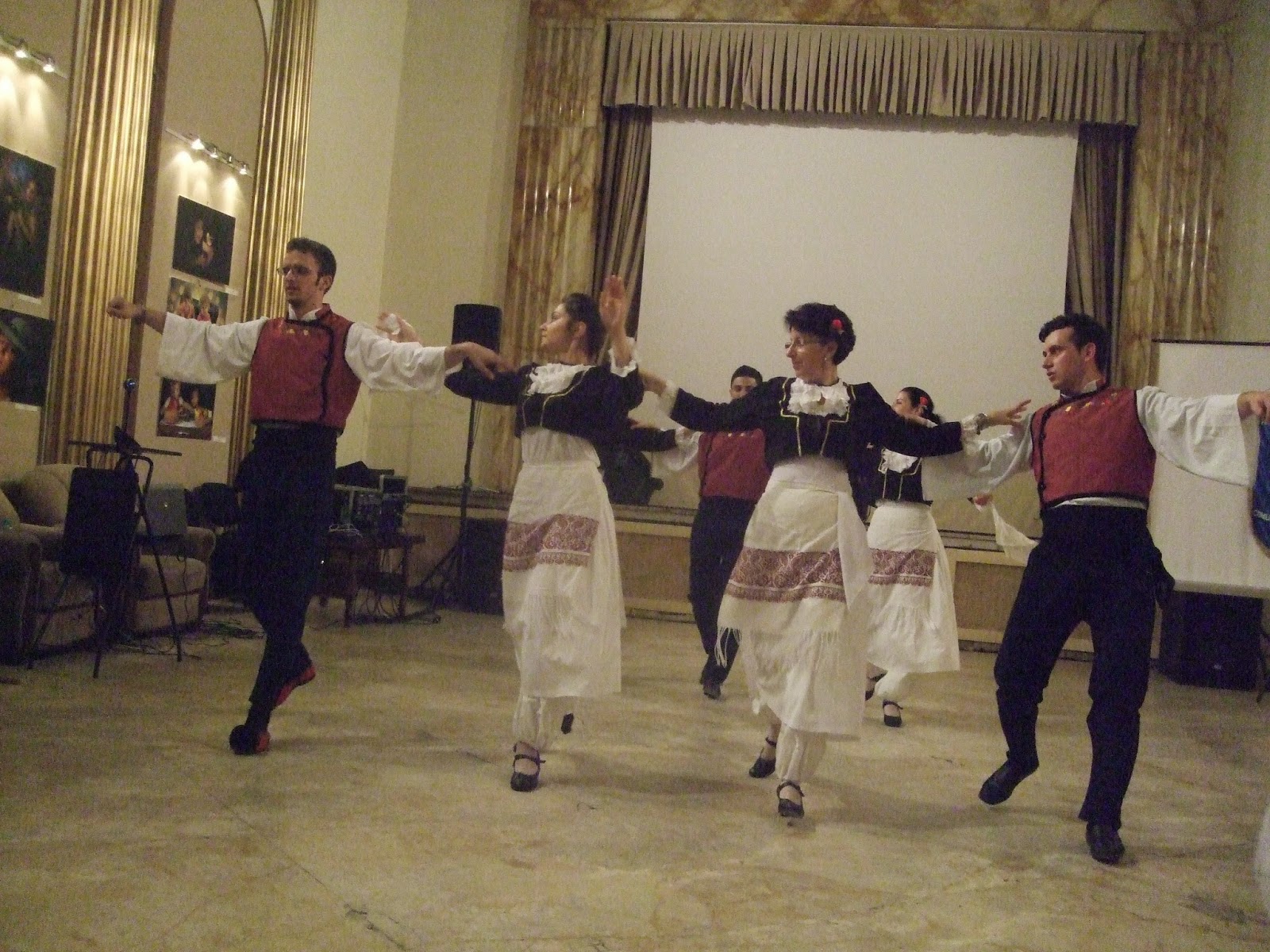
      And also, the part related to song and dance gave me a pleasant surprise. Numerous artistic assemblies of children and adults from all parts of the country have performed in front of the audience, and their performances were great - joy, simplicity, and a love for folklore. Now, I must admit I generally don't listen to folkloric music, and my knowledge of traditional Romanian dances is pretty basic. I've been a city girl all my life, and not even my grandparents were based in the country-side. However, leaving my own knowledge and abilities aside, I still appreciate folklore not as a consumer, although I love to buy traditional artefacts, all full of colour and different between themselves, according to the region they come from.  But my appreciation is especially for what folklore represents for people: a tradition which is still alive, even for the youngest generations, and which still keeps us in touch with our ancient culture.
    I believe folklore is something we should at least be aware of, no matter where we're from, and also if we don't perform it or consume it often. It does shape a country's national identity, and it will always be a part of who we are as a nation.
     

Friday, 20 June 2014

Synchronized Cultural Events: a Big Challenge to Promote Your Country's Culture


One of the latest trends in the social and cultural life of big cities is the organization of what I call synchronized events, such as the Night of the Museums, the Night of Cultural Institutes and so forth. Basically, several cultural institutions organize simultaneous events for an entire day or night. Personally, I am a big fan of such manifestations, because not only does it keep you rapidly up to date with what happens in your city's cultural life, but it also offers a wide range of shows, workshops, exhibitions, and so much more, to choose from, so that in theory it would be impossible not to find something that you like. 
     

   This evening I attended the Night of Cultural Institutes, which took place in Bucharest. And, as much as I was eager to attend this event, there was definitely some room for improvement. Nevertheless, I realized what a big challenge it is to organize an attractive cultural event, in a situation where fragmentation is a big problem. Tonight, the Cultural Institutes of Great Britain, Czech Republic, Austria, Turkey, Hungary, Spain, Romania, Greece, France, Belgium, Italy, Poland and Germany took part, to a bigger or smaller extent, in the event. Yes, all these Institutes exist in Bucharest, which is a landmark of a multicultural environment. Therefore, so many venues in just one night makes fragmentation unavoidable. Everyone wants to go to each place, and to spend a short amount of time everywhere. This means that it is crucial for each Institute to organize an interesting and lively event, which is able to grab the attention and involvement of the audience in a short amount of time. Nobody can afford to alternate lively sections with "chilling" ones, and this is what, in my opinion, was the big mistake of various institutions. Such events should be permanently upbeat, not just in certain moments. Of course, as a spectator, you will choose some events or sections of events instead of others, and you won't be able to attend everything. But at least you would be sure that no matter where you go and when, you would never be bored. And that would be the ideal Cultural Institute "crawl"! ;)
    So, what does it take? I would say that it is essential to take out the major weapons of your national culture, the most original traditions, lively traditional music and dance, interactive workshops of languages or arts and crafts, theatre and improvisation, and also traditional food and drinks. Whatever is alternative, not typical of your country, or too long to be followed actively should be avoided. In these situations, we look for something that resembles a proper celebration, is interactive, is colourful, and, most of all, gives a proper insight on the cultural identity of your country. Some Institutes succeeded, some others did not - or at least in parts. But let's hope that the following years would take this interesting typology of event to its maximum potential.