Saturday, 25 June 2016

The United Kingdom: One of Us, or in a League of Their Own?


      What else could we talk about these days? About the fact that on Friday morning, apart from the fact that I fell out of bed (true story), the first news I heard on the radio was an equally big blow: that the majority of the UK population had voted in favour of Brexit. Not all votes had been counted yet, but apparently it was still not enough for those against Brexit to reach a numeric advantage.
         I didn't see that one coming. The difference amongst the two sides was not big, but still, it counted. I have numerous British friends and aquaintances, but none of them declared himself in favour of Brexit. It's true that all of these people are well educated and from higher social spheres, and therefore they are open minded enough to see EU membership as an advantage, not as a threat. And yes, some of these people are past the age of 60. On the contrary, statistics have shown that the less educated segments of the population were those voting for Britain to leave the EU. Or, at least, they were those people who were (rightfully or not) nostalgic for a more traditional Britain or fearful for their national identity (again, rightfully or not). 
          On multiple occasions, the UK has shown the tendency to be 'in a league of its own', as opposed to an EU member who conforms. They were those (apart from Malta), who drove on the left side of the road, or who still held their ancient measurement units. Clothes and shoes sizes differ from the rest of Europe, many brand names also differ (although they are still recognizable thanks to the logos and packaging). In short, all these small things which made their society less accessible, unless you had a solid knowledge of it, or if you were willing to embrace all these differences.
     On the other hand, what about their already-existing multicultural society? Perhaps, after all the arrivals from former Commonwealth countries which made the UK (and especially London), such a mixture of different communities and cultures, this time they were really scared of further globalization. I remember, from the times when I was living there, and Romania was not in the EU yet, that they had lots of regulations regarding non-EU immigrants, apart from needing a visa and a work permit in case you wanted to work full-time. And my inner (or not) reaction was always something like: 'For God's sake, you're full of all nations possible and imaginable, and you make such a fuss over a 20 year' old Romanian student wanting to gain some relevant work experience, preferably not in a bar or in a shop? However, I believe that with or without the EU, these things are becoming part of life anyway. So, is it really something to be so afraid of?
            What will be the consequences, for the UK and for the rest of the EU?  Did they make a mistake? Most likely, yes, but I am not a political or economic analyst, nor can I predict the future. The basic things that I can foresee are some complications regarding their freedom to travel to other EU countries, as well as for working or doing business on EU territory, and viceversa, for EU citizens wanting to head off towards the UK. But we cannot foresee how things will unfold. I feel sorry for my friends who are now suffering, and perhaps a way to feel the consequences less could be found.


Monday, 30 May 2016

Indonesia: an Explosion of Colour and... Sweetness


       As my dream of travelling outside the old continent hasn't yet had the chance to come true (we could get into a debate about time and money, or a combination of the two, or about myself not being brave enough to travel alone as a girl and bla-bla-bla, but that is not the issue ;) ), as you may already know, whenever I have the occasion I attend cultural events from various countries which are, for the moment, unaccessible.
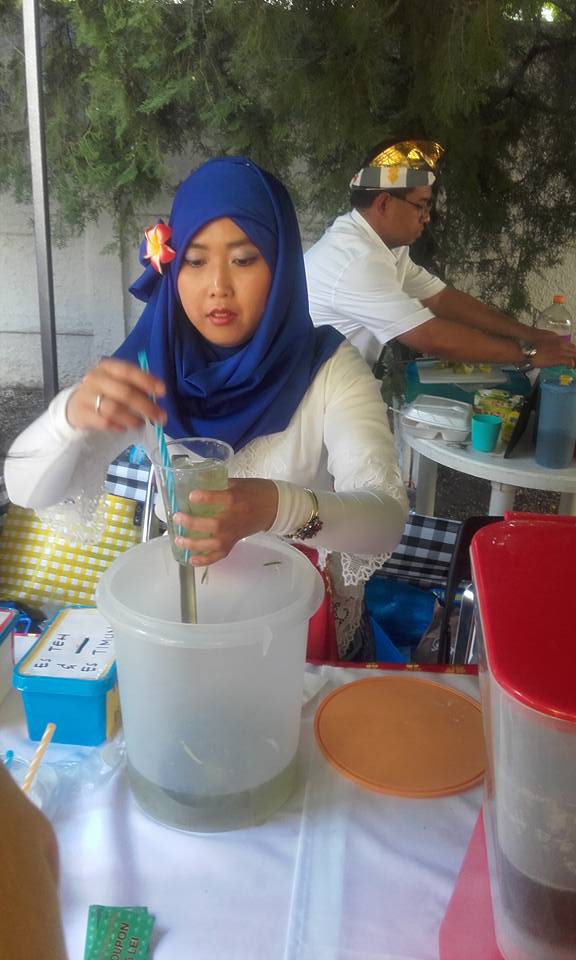
        Said and done: this week-end I popped by the Indonesian Embassy of Bucharest, where the event 'Piața Indonezia' (Indonesia Market) was taking place. It was a cultural event lasting a few hours, around lunchtime and early afternoon.
        Now, I admit that I didn't know much about Indonesia until the recent past. Well, apart from the fact that Bali is a very popular touristic destination. However, the company I work for has an office in Indonesia as well, and I got the chance to interact with colleagues from this country. And most surely, this played a major part in stirring my curiosity.


       The event itself, not being very long, contained short manifestations of various kinds, comprising different aspects of Indonesian culture. Traditional dances and music (and also pop music played by Indonesian musicians), martial arts demonstrations, clothes, handicrafts and souvenirs to buy, and, of course, local food and drinks. 
           What caught my attention especially has to do with the visual part, but also with... taste. And here are my first impressions as an outsider.
             First of all, Indonesia is about colour, flower patterns and gold. That can be noticed in their traditional costumes, and the ornaments and accessories. 


             Indonesia is also ... a friendly country. Or, so it seems, because of the politeness of the people I met, and who always wear a smile. Besides, the way they involved the public in a traditional dance says it all. Plus, let's not forget the statues, masks and mythological creatures which are amusing in themselves. 


              Last but not least, Indonesia is very sweet. On a very hot day like it was last Saturday, cooling off with a (sweet) cucumber punch, or a very fruity drink called Es Teler. The coconut pancakes which I had heard about and which I was really tempted by had finished before I arrived to the food court, but I still managed to buy some tourquoise sponge cake, also with coconut flavour (talk about colours and sweetness).
                 

                The event was interesting, but it was also brief... and overcrowded. The back yard of the Embassy was not that big. Maybe they didn't foresee such high presence, but, on the other hand this demonstrates that people are curious when it comes to culture. For next year, I hope to see more and taste more of Indonesia! 
             

Monday, 9 May 2016

Europe: Unity vs. Utopia

         On Europe Day, I cannot help but wonder how many Europeans accross the continent are really celebrating.  I haven't lost my optimist attittude, but I see an increasing number of social, political and even safety issues that Europe is dealing with. I see more and more skepticism everywhere, amongst people I interact with in daily life.
           For the past two of years, we've seen economic crises, inflows of refugees from North African and Middle Eastern countries, as well as terrorist attacks in Paris and Brussels. Countries are trying to reach a middle ground about almost everything, sometimes forgetting even about the national particularities on each country. Various European states are also turning towards extreme right political regimes, and the UK is contemplating exiting the EU.
          On the beautiful sign of the spectrum, however, we enjoy all the consequences of freedom of movement. Travelling in Europe became increasingly easy, as well as studying and working within the EU, leading people to experience the different cultures of the old continent. Friendships, cultural practices, languages, mixed families... Amongst young people in particular I still see a lot of enthusiasm, as if Europe and European identity were (or maybe they really are?) this wonderful, lifelong project, to cultivate in a wide variety of ways. 
       However, what should be done in order to still experience the beautiful part, but, at the same time, make sure we stay safe, and that modern European values are not jeopardized? Or do you think we'd be better off separating and each country minding its own problems and regulating their own societies, whilst re-creating borders for the outside world. 
        More often than not, we are tempted to link the mass migration of refugees to the terrorist attacks which recently took place. But there are also genuine cases of people fleeing dangerous situations in their home countries. How could we differentiate between the intentions of these immigrants? I recently heard some politician/opinion leader/don't remember exactly who, saying that excessive control or restriction is just as bad as excessive tollerance. In a way, I believe it's true, because when an individual or a community is getting the feeling of not being accepted, anger towards the host country tends to rise even more. On the other hand, if someone arrives already with dangerous intention, authorities not doing anything about it would only create fertile ground for more evil deeds. 
           My personal opinion would be about finding the right balance between clear immigration policies, applied firmly but not aggressively or in petty ways, and increasing the activities of cultural mediation, exerted by official institutions, and, why not, also by each individual. If faced with multiculturalism in any shape or form, we  also have the power to teach our 'outsider' aquaintances what is right and what is wrong on our territory. Or perhaps you think that somebody's individual contribution doesn't really count, and it is just a water drop in the ocean. Or you might also say that it should come from each state's institutions in authority, which at the moment are not doing enough, and they should be more strict about everything? 
                I invite you to think about it... and share with me! :)
          

Monday, 2 May 2016

How to Be an Un-official City Tour Guide


        One of the perks of having travelled substantially accross Europe (and imagine if that expanded to the entire world, but it is not my case yet), is that you get to make a large number of friends spread all over the map. Who, at their turn, will get to visit you or your city at some point in time. Are you ready to organize a city tour, and make your friends familiar with your city, in all seasons? You and I may not be qualified tour guides, who are non-stop walking-talking encyclopedias, but at least we can do the basics in a decent way. Well, I must admit that by now I have gained a fair share of experience, and here is what I learnt.


         ... inform yourself (or refresh your memory) on the most important touristic attractions, and if possible, group them in time and space slots. 
        ... choose the most interesting and pitoresque places, as well as places which highlight the national/local culture. In other words, shopping malls are present everywhere in the world and your friend has them at home too! :) 
        ... learn some factual information on those attractions, in order to present them correctly to your friends. A little bit of history, geography or architecture knowledge goes a long way.


        ... only show and draw attention to what is positive about your city. Don't take your friend to ugly or dangerous places to show him something 'sensational'. That is, if you still want him to come back. So, be a good PR for your city.
        ... choose venues that are suitable for the season and for the weather. Maybe a long walk in the park on a freezing winter day or on a 40 degrees summer lunchtime is a bad idea, just like it is to spend most of the day in closed spaces on a day which is just perfect for outdoor activities.
          .... find out if there are any particular cultural events in town, and take your friend there if you believe they'd be interested. But beware: if there is local language involved, and your friend doesn't speak or understand it, that event wouldn't be your best bet.
      ... when it comes to food, again, choose traditional restaurants. There is no point taking your Italian friend to eat pizza in Romania: he will only find it a bad copy of his own national food. Plus, if you know a restaurant with a traditional artistic programme or atmosphere, that's even better!
          ... keep budget in mind, both when choosing the venues, and, if it is the case, also when you recommend a place to stay. A tourist who is still a student will not have the same budget as a professional of some top-notch company. 
          ... be prepared to be also a translator and an interpreter, if you get to a place where English is not spoken, or if your friend himself does not speak it. 


    ... last but not least, make sure your friend is safe and comfortable all the time. For example, if he arrives alone in the middle of the night at the train station, don't let him find his way to your house by himself, amongst strange faces. Instead, pick him up by car or by taxi. Also, make sure you won't put their health and well-being at risk, and, in case of emergency, act as promptly as you can.
                As you can see, it is not very difficult. All it takes is some advance preparation, good will, consideration, and lots of energy. And of course, don't forget to enjoy your friend's company, and to enjoy the city through their eyes, as if you were experiencing it for the first time as well. The result? You will have fun and create wonderful memories together. And maybe who knows... maybe one day you decide to become a certified tour guide. ;)


Sunday, 10 April 2016

Is Your City Living Up to Its Full Potential?


     One of the major advantages of living in a capital city, or any major city, is that you keep discovering new things about it, even though you were actually born there. I have seen Bucharest going through a lot of positive transformations since the end of the communist regime to the present day. New buildings appearing in the landscape and old ones being restructured, modernization works, some of them even unnecessary, but that's another story. Would you believe that in 2007-2008 the historic center, nowadays so full of bars, caffees, restaurants and shops, and loved by tourists and locals spending their spare times, looked like World War II had just taken place? Well, I'm still astonished too.


            However, I recently discovered that what has been already done is far from enough. Bucharest has submitted its candidature as European Capital of Culture 2021. With this purpose, several cultural NGOs are regularly organizing pedestrian itineraries free of charge (or based only on donations from participants - you give if and as much as you want). These itineraries, which are very popular amongst the city's inhabitants, as tens or even hundreds of people attend every time, are meant to raise awareness to the undiscovered and/or forgotten parts of the city, hoping that the message would get to people in authority and something is done about them.


      I also attended this type of events a couple of times. And it's been insightful and saddening at the same time. Apart from the mainstream venues and touristic objectives, there are also many buildings, or even entire neighbourhoods, true jewels of architecture, which seem to be abandoned, perhaps claimed by some (real or fake) owner from the post-communist era, and left to deteriorate. Or neighbourhoods full of stories and legends from times past, which are now only inhabited by poverty and social cases. Or, a huge inhabited land by a lake generated a proper natural reservation, which is almost competing with the Danube Delta. Or, an amphitheatre which had started being built during the communist days with the idea of becoming a summer theatre is now abandoned and useless (well, I know communism has done lots of injustice to the population, but a summer theatre would do us good, as we like to have a rich cultural life in all seasons).
                   

          Bucharest has grown, but it can grow even more. I don't know if these things happen in all cities. I don't even know if action will be taken, or at least anytime soon. And I'm not that rich to become a top-notch land developper, 'cause otherwise I would. :) But one thing is certain: we cannot afford to lose such beauties, which can make our city an even more charming place. 
               

Friday, 29 January 2016

'When You're in Rome, Do as the Romans Do': a Story about Hosts, Guests and ... Statues


    During the past few days, we have all been mesmerized by a funny, yet cringe-worthy story which made the news headlines. The Italian Government decided to cover with panels all nude statues in Rome's Capitoline Museum, on the occasion of the official visit of Iranian President Hassan Rouhani. The reason was the (excessive, I'd say) concern not to offend the Iranian politician's values.
      Right. Apart from being, as I said above, an exaggerated diplomatic move, I wonder if really the Iranian President had asked for it. Somehow, I doubt it. Plus, we can assume that the man is cultured enough to know about art, to know what to expect in a European country, as much as not to feel offended. Plus, it's not like they were real naked people! :P Most probably, this decision came from a place of over-eagerness to please someone with a higher power. 
        It made me think of the famous proverb 'When in Rome, Do as the Romans Do'. And this time, it must be taken in its literal meaning. In general, when you visit another country, the tendency is to adapt to the laws and customs of the local population. It is good, as a host, to make your guests feel welcome, but without exaggerating, and without ending up losing, or even disrespecting your own national identity. 
           Where do you think boundaries should lie? Even us, mere mortals, can analyze this issue. :) Most of us have been 'guests' in other countries. More often than not, we gladly immersed ourselves in their cultures, or at least we've been curious enough to discover it thoroughly. If the stay was short, the discovery was like a game to be fully played for the entire period of time. If the stay was longer, from several months to a lifetime, adaptability was key in order to live there legally, and also to be socially integrated. Moreover, if that world did not resonate with us, we were less likely to remain. 
        As an immigrant and a traveller, I definitely came accross aspects which were totally uncompatible with my values, and I'm sure you did too. But from here to feeling offended, or taking it personally, and expecting those people to change (on a national level, evenutally) just to please you, it's a long way. 
                As a host, we should definitely offer an environment which is friendly and non-threatening to the guest, do whatever lies in our power to make integration easy, but without chopping away our own values. Our country is like our home, and if we cannot be ourselves in our home, then where? 


Tuesday, 1 December 2015

Celebrating Unity, Learning Solidarity: How We Spent Romania's National Day


    Today Romania is celebrating. It is our National Day, also known as the Great Unity, the day when, 97 years ago, we became one big country. Live music, people gathering from all the corners of the city, Christmas lights and national flags colour and illuminate the scenery in several cities. In general, for us, this represents the opening of the winter festivities season.
        However, this year everything took place under a dark cloud, or at least many of us feel like this. Those who have been following the news know that exactly one month ago a major tragedy took place in Bucharest. A nightclub caught fire during a rock concert, causing a total of 60 deaths and hundreds of people injured. Apart from the tragedy of all these lives lost or harmed, it was discovered that the club was functionning illegally, without respecting some key safety laws. In other words, corruption had helped the club function, although, legally speaking, it should have not. 
            Last month's tragedy was a (new) last straw in a world where corruption had been reigning for many years, and this time corruption had been at the foundation of a tragedy of proportions. What followed for the entire country was a mix of grief and anger, between flowers and candles for the victims of the club Colectiv fire, and street protests against a flawed governing class. The protests were peaceful, and fortunately no episodes of violence were registered. In the end, as you might also know, it culminated with the resignation of the entire government, which made most of the country rejoice, but also hope for better times ahead for our country.
           How did it feel to be among the protesters? From my own experience, it was a feeling of togetherness. I didn't know those people, but we were all there for each other and for the future of our country, regardless of age or social status. 
        What did we learn from this experience? That we CAN stick together and be united, if we want, and results will show, although for some people it was too late. That Romanians are not as individualist as I often accused them to be. That a country that is (geographically) big, deserves also to be great. These days, one month later, I often feel that people are much more open towards each other, but also to believe in ourselves as a nation, and turn towards our real values, and to those of us who can make Romania a better world. Some friends of mine who are (still) a bit cynical will accuse me of being (still) idealistic, but I love them anyway! ;)
            What I wish Romania for her birthday (gee, she's one old lady ;) )? To keep improving in this respect, to keep learning solidarity and respect for the others, to value safety and justice above material interests, to learn to trust and also help in times of need. And of course, a lot of strenght for the fire victims' families and also for the survivors. 
              Happy birthday, wonderful country of (actually and potentially) great people! La mulți ani, România!