Tuesday, 22 November 2016

Athens: Chasing Greek Gods, Exploring Greek History (Part 2)


   After having seen some of the most famous archeological sites, which are probably the first landmarks that comes to mind when we talk about Athens, let's proceed to other places worth seeing.


      Syntagma Square, where the Greek Parliament is situated, is the city's central square, as well as the main meeting point of all means of public transportation. So, inevitably, you will end up there and you will pass by several times during your stay. I suggest that you start a day with a small visit to Syntagma Square, and be there about 15 minutes before the hour becomes sharp. Why? Not because Prime Minister Tsipras is offering you some Ouzo, but because you absolutely must witness the change of guards. The soldiers guarding the Parliament are really nice to watch. 


They wear Greek traditional costumes and are really... unmovable. Serious, straight, no facial expression. You can take pictures of them, but without crossing a certain line. Or, when the surveillance guard allows, you can come close and photograph yourself next to them. But, beware: you must not touch them, or move around them. Otherwise, you will watch them walking around with ultra-synchronized movements, that they really look like toy soldiers. And when the guard changes, it is a real show going on. It doesn't last more than ten minutes, but it is surely very dynamic and very precise.

       Athens is full of museums, from more general ones, to more thematic ones (war, Cycladic art, ceramics, folklore, musical instruments, numismatic, and so much more). Unfortunately, with such a short stay, you will not have time to visit them all, much as you probably would like to. However, I will advise you to visit two very important museums, the National Archeology Museum and the Byzantine Art Museum. Of course, beware that on Mondays most museums are closed.


     The National Archeology Museum is still about rocks, of course! :) Jokes aside, it is a complete incursion throughout Greece's history, from prehistory to late antiquity. 


 Marble, gold, bronze, frescos and so much more, together with textual explanations of the historical times associated. My personal favourite was the Cycladic section, as well as the Tyrins wall paintings. 


Plus, impressive collections of vases, statues of the most important gods and mythological creatures of Ancient Greece, and so much more. Zeus, Aphrodite, Posseidon, and poor Dyonissus, who must be really suffering... from too much wine! ;)


 The Byzantine Art Museum is also very emblematic as far as history is concerned, especially because it would somehow continue the historical evolution, from late antiquity to late middle ages. 


It does contain a high quantity of religious art, but not only. You will also see costumes, numismatic, documents, sculptures, reliefs, and craftwork of various types. Not to mention that the building itself is a work of art. 

             Another museum which I came accross totally by chance is the Folklore Museum, situated in the Plaka area (we will talk about it more in the next post).


It is very small, and no entrance fee is perceived. Actually, it almost looks like a shop. Nevertheless, it is full of colour, handmade object of various types, and in various fabrics, from paper to ceramic and glass, as well as colourful paintings and dolls in traditional costumes. Apparently of an innocent simplicity, but, as you look, you start to wonder how human hands could be capable of such patience and minutiousness.
           In our last post on Athens, we will talk about the city's vibe: colour, taste, noise, how to get around as a tourist, and a bonus day trip to a very charming and relaxing place. 


Sunday, 13 November 2016

Athens: Chasing Greek Gods, Exploring Greek History (Part 1)


     Those of you who know that I was away last week, I am sure that you've been looking forward to know about my experience in Athens. And now is the time. Actually, this is the first of three portions. My trip to Athens was a 4 day city break, to celebrate my I-forgot-the-number birthday. :P It was not my first time in Athens: that happened when I was in high school, on a school trip, and the second time was 4 years ago, but it lasted less than 24 hours, before I embraked on the bus to Patra. Therefore, this was the time when I was grown-up enough to know what to explore, and how to explore a city.
    First and foremost, keep in mind that Athens is indeed full of history, which goes back 5000 years. And, when we think about ancient history, Athens and Rome are the ultimate places to be. This time though, we are talking about the 1st of the two cities. Sometimes we joke that we go to Athens to see rocks, but we know that it's simply amazing how these antique sites have lasted for milleniums, and they represent precisely the main charm of the city. So, let me take you through the most famous 'rocks' of Athens! ;)


     1. Acropolis

     Its name in Greek means exactly 'the high city', and is surely the most famous landmark of the Greek capital. Situated on the top of a hill, the Acropolis dominates over the rest of the city, and consists of several archeological sites making up a small citadel. It was also declared UNESCO World Heritage in 1987. We were very lucky to visit it for free, as it was a special offer of the first Sunday in November. Otherwise, visiting the Acropolis costs 30 euro per person. So, saving a significant amount of money for seeing the symbol of Athens was one heck of a birthday present! ;) Also, the fact that we arrived there at the first hour of the morning surely helped, as we had time to see everything before the place became packed with tourists. 


 As I said, the Acropolis comprises various parts, but seeing them will not take you more than 1-2 hours. Of all of the sites and temples, I will draw your attetion to the Parthenon, perhaps the most important landmark, although at the moment it's under reconstruction, so you won't see it in all its splendour. Afterwards, it is worth mentioning the Theatre of Dionysus, the Temple of Athena and the entry gate Propylaea. 


     2. The Ancient Agora

     Downhill from the Acropolis, you can find the Ancient Agora, what in ancient time used to be the main square of Athens, where the citizens used to gather for a wide variety of purposes. 


Also, this is an archelogical site which includes several components, of which the most important are the Odeon of Agrippa, the Temple of Hephaistos (which bears a striking resemblance to the Parthenon, so be careful not to confuse them), but also the Museum of Ancient Agora at the Stoa of Attalos, which is a picturesque setting in itself, and exibits several artworks and ancient remains. The Ancient Agora is like a park in which you can take a quiet stroll, and is not as full of tourists as the Acropolis. 


      3. Temple of Zeus and Adrian's Arch

      The last-but-not-least archeological setting, situated withing walking distance from Syntagma Square and right next to the National Gardens, Adrian's Arch was build in the 2nd century A.D., and it was meant to separate the old and new cities of Athens. Just as you cross it, you enter the site of the Temple of Olympian Zeus, where the entrance only costs 3 euros per person. This visit will be quick, but nevertheless worthy, as it is an ancient spot in the heart of this hectic city.


     In Part 2, we will be back with Syntagma Square and something which you should not miss about it, as well as two key museums encompassing the history of Greece, but also the perfect place for shopping in Athens. 


Wednesday, 2 November 2016

The Romanian Traveller: Sinaia - the Town where You Feel Like Royalty (Part 2)


     After we started our trip to Sinaia with castles Peleș and its little brother Pelișor, we will continue with other picturesque tourist attractions, which you may or may not have heard of. In fact, compared to the two castles, these venues are less packed with tourists, which means that you have more time and space to enjoy your time there.


Sinaia Monastery

For the more religious of us, but not necessarily, the Sinaia Monastery is worth visiting for its architecture and sensation of peace and calm that it creates. You know me, I am not exactly a religious person or a church goer, but I must confess that this place has something special. It's like you feel close to... God... divinity... your departed loved ones... or whoever you choose to believe in. 


Apart from the main church, which is very artistic and imposing, like most Orthodox churches, there is also a smaller, old church, which we found empty. No priest, no sermon, no other tourists. Silence, and just perfect to find some peace of mind, and admire the antique painted icons on its walls, which time has partly erased. Also you must not miss the Museum of Religious Art, which might appear closed, but it's not. All you have to do is ask the guard, and someone will open it and guide you around. The most interesting part of it is that you will learn about the history of the town of Sinaia.


The George Enescu Memorial House

George Enescu (1881-1955) is Romania's most famous composer of worldwide fame. And in the 1920s he had this house built in Sinaia, to which he periodically used as a retreat and a place to create. Beware though, that the road till you get to the house is long, although the direction signs are present even from the center of Sinaia. Don't be tempted to believe that it's near the center, 'cause it's not. You will have at least 30 minutes to walk, and you'll even end up in some 'middle of nowhere' place, close to the railroads, and you might even think you're lost. But you're not lost, rest assured that you'll get there. The good part is that it's a plain road, so no hills and mountains to climb. 


However, as soon as you get there, despite the long road and the proximity to the railways, you will understand that it deserved to be an artist's oasis of silence. The villa is quite big, but it does not take a lot of time to visit it. A spacious terrace with a garden view, a succession of pretty and cosy rooms, each of them tastefully decorated and serving a specific purpose, ending with a small museum on the top floor. At the entrance, you will be given audio guides in various languages, which explain everything about the house and each room, but also the story of George Enescu's life. 


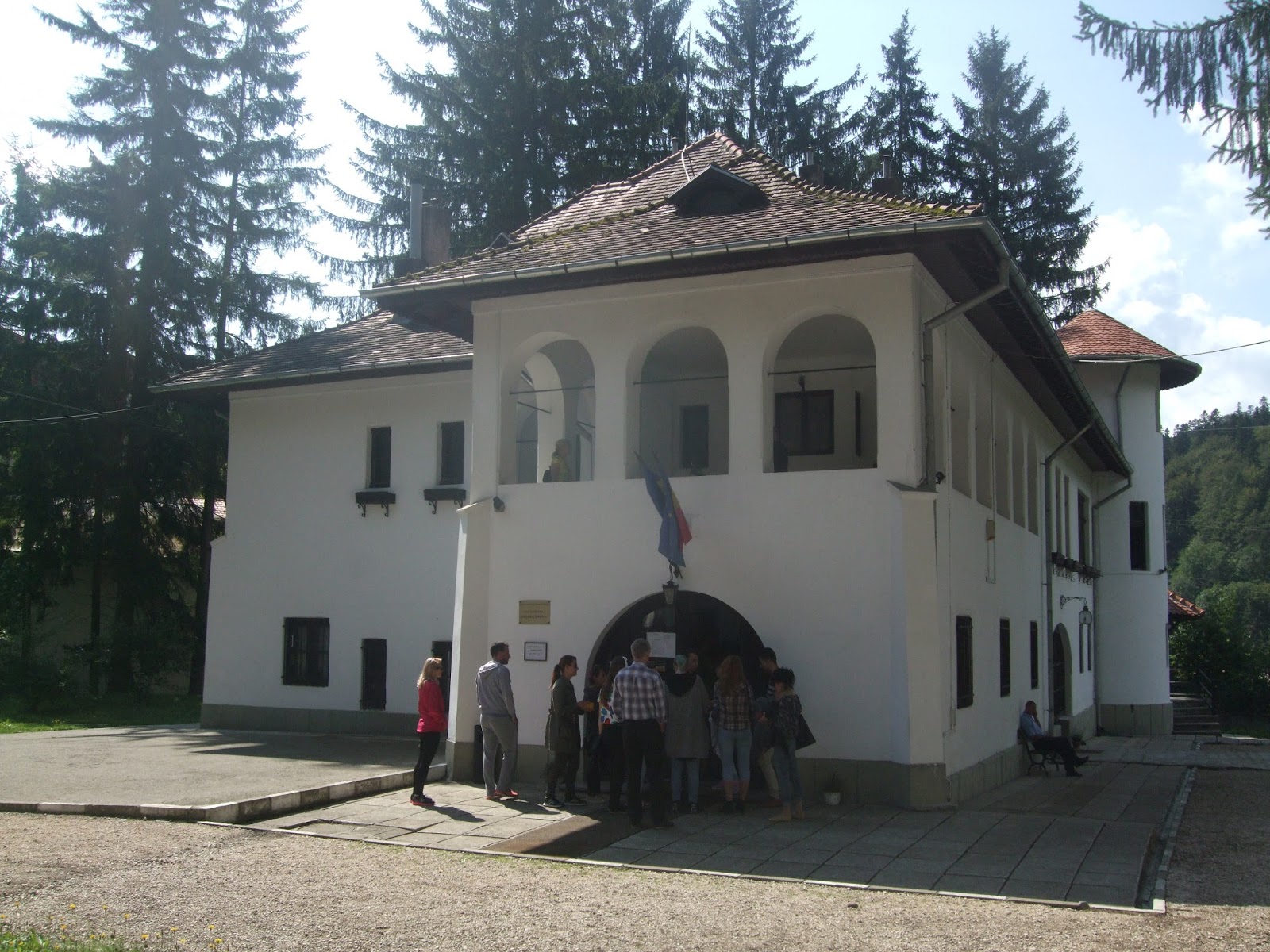
Sinaia City Museum (Stirbey Palace)

More than just a museum, this little castle is actually an architectural gem hidden on a small street parallel to the main road, and behind other houses. But you definitely should not miss it. 


First and foremost, it is worth even to be admired from the outside, and on the inside you can find just enough information related to the city of Sinaia, its history and its development accross time, in documents, objects, images and filmed footage. You do not depend on guided tours, but all necessary explanations are on display in each room. 


***

How to get to Sinaia? Most residents of Bucharest go there by car, but the train can also be a good solution, especially because Sinaia has the prettiest train station that I've seen in the whole Romania, also known as the Royal Station. A wide range of accommodation solutions is also available, from villas to high-brow 4 and 5 star hotels on the main road. Plus, you can find everything that you want also in terms of shops, supermarkets, restaurants, souvenirs and handicrafts. After all, Sinaia is not just a touristic resort, but a town in its own right.

Beauty, elegance, and a fascination of times past. I think that it sums it up. Go and convince yourself! ;)  


Sunday, 23 October 2016

The Romanian Traveller: Sinaia - the Town where You Feel Like Royalty (part 1)


     I haven't taken you around Romania anymore lately, have I? Well, now it's the time for me to make it up to you. Especially now, that I am about to present you a destination which is worth the visit in any season. 


       Have you been to Sinaia? For the inhabitants of Bucharest and southern Romania in general, it's probably the most popular mountain venue and ski resort, as it is only a couple of hours away from the capital city. By taking a look at the pictures, you probably wouldn't even believe that it's not Switzerland, or Bavaria, or similar, but just good 'ole Romania. 


     Apart from trekking and skiing, Sinaia offers also lots of opportunities for cultural activities to the less sporty types (Gee, why did I feel the need to mention that myself? :P ). The town is very clean, with lots of green spaces, but what stands out the most are its charming houses, from various periods in history, of which most of them are of national patrimony value. And of course, its touristic attractions which you absolutely must not miss.


            Peleș Castle: 
            The absolute masterpiece, built under the reign of King Carol I as the summer residence of the Royal Family, from 1874 to 1914. The castle is open to visits from Tuesday (Wednesday in winter) to Sunday, from 9 a.m. to 4 p.m. and tourists are organized into groups with a limited number and led by a guide through all its chambers. Apart from Romanian, guides are available also in other languages, such as English, French, Spanish and Italian. My personal advice is to visit both ground floor and first floor, although it would cost you a little bit more: 50 RON in total for adults (about 12 euros), with discounts for children, students or pensioners. Be aware that taking pictures is not included in this entrance fee, and if you wish to do that, you have to pay an extra 32 RON (8 euros). Again, yes, taking pictures would be cool, but I must warn you that it will be pretty uncomfortable. Tourist groups tend to be numerous, and it will be a big effort to follow the guide, admire the view, be careful enough to watch your steps without bumping into the other tourists AND take pictures. 


Instead, listen to the history of Romania's Royal family, the episodes that marked their lives and their reign, or the routines of the royal couple. Admire all the chambers full of collections brought from all the corners world, weapons, carpets, books, furniture, artwork and so much more. From the outside, however, you can take as many pictures as you like, and, thank goodness, it will be a lot to photograph, from panoramic view of the castle, to all its sides, angles, and artistic details.


          Pelișor Castle:
       As the name suggests, it is like the little brother of Peleș Castle. Not by far as imposing as the latter, Pelișor must not be neglected either. It is situated within walking distance from Peleș, and its innauguration took place in 1903, with the role of summer residence for Prince (and future King) Ferdinand  and his wife, Queen Maria. On the outside, the castle looks more like an aristocratic house in Tudor style, and on the inside, although it still contains precious works of art and furniture, it looks more cozy, resembling an actual home. The full entrance fee is 20 RON (less than 5 euros), with the same discounts applicable as for Peleș Castle, and guided tours are also organized in groups. Same rules and same fee apply also for taking pictures, and, of course, I will give you the same advice as above.


        For some reasons, these two castles have always given me a sense of warmth and a sense of national pride. For a Romanian wallet, they are not particularly cheap to visit, but it will be always worth it. Moreover, I think I will do it again someday. And perhaps, who, knows... I may actually do the heroic extreme-sport of taking pictures and show them to you. ;)
        In part two, we'll be back with other touristic attractions, as well as general informations about Sinaia.
        

Thursday, 29 September 2016

Matera: from 'Shame of Italy' to European Capital of Culture


      After I told you about my trip to Puglia, I still owed you an Italian travel story, the last one for this year. And so it went, that on one of the days of this trip, we ended up in the neigbouring region of Basilicata, historically known as Lucania. Perhaps not many of you have heard of it, but this region, situated between Puglia and Calabria, is also home to Matera, the European Capital of Culture of 2019. Indeed, not even I knew much about this city until its designation, back in 2014. 


     What makes Matera so special? First of all, it doesn't look like anything else in the world. Its rocky historical center, also known as 'I sassi di Matera' ('The rocks of Matera'), is part of the UNESCO World Heritage since 1993, the first one in Southern Italy. The 'sassi' are divided in two main areas: 'sasso Barisano', situated in the direction of the road to Bari, and 'sasso Caveoso', consisting of cave houses, carved in calcarous stone, and probably inhabited since prehistoric times. 


       However, until the 1950s, Matera ended up being known as 'the shame if Italy'. Because, in these rocky houses, where nothing had been changed for centuries, entire families were living their lives in dire conditions. Can you imagine a small room, where a family of 10-12 members plus their domestic animals were eating, sleeping and living their daily life? Now we can, because these houses can be visited as museums, with guided tour included. Unbelievable as it may sound, this situation carried on until 1952, when Alcide De Gasperi, Prime Minister at that time, decided to move out the population of the rocky houses and started off the city's restructuration. The action was met with great resistance, but in the end all is well that ends well. Nowadays, apart from the historical and cultural value, many of these houses are also hotels, restaurants, shops and even homes, in spite of the high level of humidity.


     Here in Matera I also discovered the creativity of the people in connection with... food. Matera is famous for its bread ('pane materano'), and the people in the past were so poor, that they invented the 'cialedda', which is nothing more than bread salad. A mix of bread chunks, tomatoes, cucumbers, olives, herbs and olive oil. Talk about turning something as simple as bread into something that may sound strange at first, but I am telling you that it's delicious! And it all goes better if concluded with a small glass of Amaro Lucano. :)


      Nevertheless, Basilicata has remained one of Italy's poorest  and most remote regions, with under-developped infrastructure and offering very few career opportunities. However, it is hoped that with its newly-found status of European Capital of Culture, people from all over the world will start informing themselves more, consequently making tourism grow, and, at the same time, also the overall economy of the region.


       My advice is to visit Matera at least once, and at least for one day. If you are looking for a place that is everything but common, with astonishing landscapes, and stories that will leave you speachless, here is your next destination. And of course, I wish Matera good luck with its new role, and to bring Basilicata and its people a well-deserved local development. 
          

Saturday, 24 September 2016

European Day of Languages: Learning and Fun in One Short Event


       In 2001, the European Commission has established the European Day of Languages to be celebrated on the 26th of September each year. And today I managed to attend this event in Bucharest for the first time, as for the past years I never seemed to make it, for one reason or another. 


          How was the event organized? In the yard of a famous Bucharest museum, several stands of the various European Cultural Institutes with a headquarter in our city, were waiting for their numerous visitors. The participating countries were: Germany, Turkey, Belgium, Great Britain, Portugal, Greece, Austria, France, Italy, Poland, Hungary, Romania, Czech Republic, Spain, and of course the Representation of the European Commission in Bucharest.
          Each of the presenting countries made guests complete a task. This could be a cultural quiz, to verify your general knowledge about a specific nation, guessing famous landmarks from pictures and placing them on the country's map, matching fragments of literary texts with titles of literary works, memorizing games based on factual information on a specific city, or matching the meaning of certain words between Romanian and the host country's language.


        What did I learn today?
         .... Germans are not a hard nation to figure out. I scored 6 out of 10 questions from the cultural quiz of the Goethe Institut. So far so good, given the fact that I just started learning their not-so-easy language!
    .... Turkey is an amazing country, with spectacular landmarks. I really wish them more peaceful times ahead, so that everyone can relax and enjoy this country's beauties.
         .... I still know my English children's literature pretty well. Not one single mistake! And the Earl Grey tea I was offered crowned (ha!) my success.
            .... Portugal is a country that I'd like to visit in the near future. And for my seaside holiday in Algarve (nothing more, nothing less) I will need: chinelos, guarda-sol, toalha da praia and fato de banho. All clear, right? :)
            ... Greeks are even easier to figure out. From their 10-question quiz, I only got 1 wrong. And I got myself a map of Greece, in honour of my next travel destination (hint, hint!) :)
            .... I was warned that the quiz about Paris was difficult. But I got it right from the first time. And surprise: my French was not as 'imparfaite' as I thought!
          .... thanks to the Istituto Italiano di Cultura and their landmarks pictures, I found out even how Caserta looks like (one city I knew almost nothing about, apart from the fact that it's in Campania). They organize free movie evenings once a week, and the guy hosting the stand was really nice and cool. And Sicilian. ;)
            .... Hungary is a paradise of thermal water spas. Which sounds interesting! Brochure: taken. Koszonom szepen!
          .... Czech and Romanian have several similar words. Only the spelling can be tricky. But, with a bit of Staropramen beer, you might even become fluent!
             .... Polish and Romanian instead are sharing some pairs of homonyms. That is, words spelled and pronounced the same way, but which have different meanings in each language. For example, Romanian word 'pas', meaning 'step', in Polish means 'belt'. Or 'obraz' means 'cheek' in Romanian, and 'picture' in Polish. Not to mention that I came with 2 big brochures about Polish cities and touristic attractions. Time to consider another trip! :)
              .... switching languages may not be as difficult as one might think, but you might need an extra bit of concentration. Today I spoke English, French, Italian and Spanish with the relevant stands in a matter of minutes. And it was not difficult at all. On the contrary: it was actually fun.
             EDL is one of those events which are both fun and educational, and it doesn't last too long to visit each stand. Therefore, it is easy to squeeze between other commitments during the day. My only advice is not to lose your patience with the other visitors, as it is a pretty crowded event, including also families with children. But this demonstrates that people are up for some higher-level activities, not just watching reality shows on TV. And this can only make me happy!