Sunday, 14 August 2016

Love Thy Neighbour: the Bulgarian Summer Experience. Part 2 - Ceramic Factory and Cape Kaliakra


      The day trip we took to Cape Kaliakra and Balchik deserves 2 separate entries, because it was in itself an enchanting experience. Even with the (probably) 40 degrees outside, I still recommend it. 
          First of all, how can you go on these day trips? In Golden Sands, all accross the resort, there are several small tourism agencies organizing various day trips - apart from this one, we had options such as Nesebar, Varna, Albena, Bulgarian country side, or even Istanbul. And we chose Kaliakra and Balchik. It cost us 30 leva for the trip plus other 17 for the entrance to touristic attractions, which would mean roughly 20 euros. 
          The funniest part is that we were told we'd have an English speaking guide, which was true... only partially. Because on the bus, we were the only 'outsiders' in a group of Russian tourists, with Russian speaking guide. Fantastic! That means I also got to practice my listening skills in Russian, and also make very basic conversation with the ladies sitting next to me.  However, when it came to important organizational information, I was not confident enough in what I understood, and I always had to ask twice, or ask for written timetables to be shown to me. But in the end, we did have an English speaking guide once we got to our touristic attractions. 
      Our first stop was at a small ceramic factory on the way. It is a small and pretty house with a garden, which adds an extra joy to the visit. Creating ceramic objects is another traditional craft common to Bulgaria and Romania. We had the chance to watch how colour is prepared, how objects are molded by hand, and later painted. And of course, stroll around the shop, admiring everything that could be done with painted ceramics, in an explosion of colours, shapes and motifs. 


      Next, we headed towards Cape Kaliakra, and up till that point I was not yet aware of what I am about to advise you now. Please beware of the fact that you will travel around midday and early afternoon, when the sun is at its strongest. Wear light and comfortable clothes, as well as comfortable shoes, because you will walk a lot, and go up and down hills and stairs. A hat, lots of water and sun protecting cream will also help. There is not much vegetation on Cape Kaliakra, or trees to keep shadow. Only the breeze can refresh a bit, but not as much as you would need.    


     Cape Kaliakra is like a narrow peninsula and natural reservation, but also military base, situated in the north of the Bulgarian Black Sea coast. It is distinguished by vertical cliffs, raising about 70 meters above the sea, remains of the ancient fortress with its museum, and, last but not least, a magnificent view, which apparently it is also a famous spot for observing dolphins, but we were not lucky enough.        


             In spite of everything, the landscape is worth all the frying under the sun, as it really gives you the feeling of being on top of the world. And also gives you a complusive need to jump directly into the sea from that height, and refresh yourself once and for all! :D 
              Also, be prepared to hear lots of mysteries and legend linked to the place. What is the meaning of the statue greeting you at the entrance? What happened there during the Russian-Turkish war in the 18th century? What is the legend of the 40 maidens? I will let you find out!


          The third ans last portion of my Bulgarian trip will be about Balchick - a territory moved back and forth from Bulgaria to Romania, and which is the ideal place to relax. Stay tuned! 


Sunday, 7 August 2016

Love Thy Neighbour: the Bulgarian Summer Experience. Part 1 - Golden Sands


Summer has arrived, and, after a lifetime of faithfully honouring the Romanian seaside, this year it was time for something different. And, knowing that many Romanians are often choosing the Bulgarian coast of the Black Sea, for better prices and services... why not? Let's see what our neigbours are up to.
       First of all, we must mention that the price has been more convenient indeed. Otherwise, the seaside experience is pretty much similar to the Romanian one, in terms of locations, people, beaches and landscapes. However, my advice, especially if you're Romanian (but also if you're not), is to look at it as more of a cultural experience, rather than your typical seaside holiday. Here is why...

                    
       Amusingly, from the political point of view, Romania and Bulgaria seem to come together in a package. After all, we did join the EU on the same day, and now we're waiting together for being accepted into the Schengen area. Nevertheless, I discovered that Romania and Bulgaria share quite a lot of cultural similarities, which are visible even from the moment you cross the Danube into the Bulgarian territory, in the city of Ruse, and later in Varna. Same architectural styles, from the so-called 'communist apartment blocks', to the elegant houses from the early 20th century, which remained unaffected by urbanistic transformations. 
             Afterwards, the first thing that will strike you is the language, the least similar feature between the two countries. Bulgarian is a Slavic language, using Cyrillic alphabet, so be prepared for that.  If you have at least some knowledge of Russian, that would come in handy - at least you will be able to read cyrillics with ease, but beware that there are a couple of letters which should be read differently, and also several words and phrases which are not the same in the two languages. The best thing you can do is buy a small Bulgarian conversation guide, in order to get by. Not everyone speaks English, especially some of the people you will interact with as a tourist: hotel staff, waiters, shop assistants, taxi drivers, etc. 


     Golden Sands is quite a fancy resort. From small and pretty hotels, to luxury ones, you can certainly find accommodation for all tastes and budgets. If you want a populated location and a vibrant night life, with many shops, bars, clubs and restaurants, then surely the central area of the resort is for you. Money-wise, the Bulgarian currency is the Lev, and you would be better off withdrawing cash from the cash machine (although there are not so many in the resort), rather than exchanging at an exchange office. 


          If, however, you need a more quiet holiday, and sleep at night listening to the waves, then I suggest to move towards the Chaika area. However, as far as the beaches are concerned, I haven't seen much difference from the Romanian ones, both from good and bad points of view. An abundace of seaweed, although the central part of the resort is clean, beaches full of armchairs which you have to pay for, and in some places quite a rocky sea bottom. But if you are very keen on swimming, a good idea is also to choose a hotel with a swimming pool. I did, and I was very glad! Be careful that the weather is hotter than in Romania, therefore at around 8-9 a.m. it's already hot enough to go to the beach, and to throw yourself into the water at the speed of light to refresh yourself, just like around 11-12, the sun is already too hot to handle.


 Bulgarian food is simple, healthy and delicious. Various types of salads, of which the most popular are shopska salad, made just of tomatoes, cucumbers, peppers and grated cheese on top, and also shepherd's salad, which, apart from the above, you also add boiled egg, diced ham and mushrooms. Or, for the heat outside, nothing is better than tarator: a traditional soup made with cucumbers, yoghurt, dill and olive oil, served cold. Otherwise, as an apetizer, you can try lyutenitsa, the Bulgarian brother-from-another-mother of Romanian zacusca, which is a vegetable spreadable paste made with eggplant, tomatoes, peppers and carrots. 


Most dishes are based on vegetables, yoghurt, grilled meat, fish and seafood. So, yes, I ate very well without gaining weight. Yeeey! Last but not least, I was often asked if I booked the hotel with 3 meals a day all-inclusive. The answer is no, mainly because... what if you don't like the hotel restaurant? Or what if you would like to eat in a different place every day? Consider that too before booking your hotel.


             And, for the last part of this first chapter, I left my favourite aspect of Bulgarian culture. Well, my dears, in Bulgaria everything is coming up roses... literally. For years and years and years, Bulgaria has been famous for cultivating numerous types of roses, which are used for various purposes. Of course, the most easy to find are the cosmetics based on roses (mostly for ladies, but also for gentlemen) - perfumes, essential oils, skincare and haircare products, soaps, bath salt, and so much more. Last but not least, roses are also used for sweets, in honey, confiture, and different types of sweets. Very sweet, so you need only a little at once, but a very particular taste. 
               In Part 2 we will talk about a very special place to visit on the Bulgarian coast. What will it be? 

Friday, 15 July 2016

To Like or Not to Like Milan: That Is the Question!


      Let me introduce you to my second home. As many of you already know, the first time I emigrated to Italy with my parents was on my 2nd birthday, and since then our lives remained some sort of permanent back-and-forth between Bucharest and Milan. Milan may not be the typical setting of Italian movies, neither is it romantic and unique like Venice, or full of history and culture like Rome or Florence, or all sea and sunshine and Mediterranean food like Southern Italy. Plus, if you ask any of my friends from the South if they like Milan, 90% will tell you that they hate it! :)
       Nevertheless, it has its own charm and atmosphere. And I love it. Apart from all the childhood memories associated, I will give you various reasons to love it too. Or at least to visit it.
    Most of its buildings are massive, yet jewels of architecture. Milan is known mainly as the Italian capital of business (this is what brought us there in the flourishing 80s as well), being home to most Italian headquarters of major national and international companies. But also the capital of fashion and brands, and in some cases you actually feel like some stores have remained unaltered since their first opening, keeping their image and their quality intact. 


      Milan is also the most multicultural city in Italy, and the fact that it hosted Expo 2015 is confirming this fact. Plus, it is home to various immigrant communities, although this is quite a controversial topic, which would deserve a separate entry. 

As a tourist, you will surely not miss Piazza Duomo, by far Milan's most famous landmark. From the heart of the city, you can go towards any direction, and you will have something to do or to see. As you come out of the Duomo (after some more or less serious queuing), on the left hand side you can pop in and visit some arts exhibitions at Palazzo Reale or Museo del '900. 


Or, on the right hand side, you can first look for the Rinascente, one of the most famous Italian department stores - but please make sure you have enough money on your credit card, or, if not, make sure you leave quickly, in order not to see too many things that are 'over-budget'. :) 


Afterwards, on the same side, you come accross Galleria Vittorio Emanuele II, which is full of fancy restaurants and designer label shops. You have to cross it, and I will also give you some homework: there is a bull somewhere. You have to find it and discover its legend. Afterwards, you will have to be less-than-nice to him, but you will see that there is a good reason for it. :) 


When exiting the gallery, you will come accross Teatro alla Scala - if you like opera, that's the place for you. Tickets to shows can be bought in the office located in the Duomo subway. Queues are sometimes long, prices are high, but I assure you it is worth it. You will feel really classy. 

Or, if not, let's go back to Piazza Duomo and go straight ahead as you come out of the cathedral. Enter Via Dante, and stop briefly to admire the different architectural styles of Piazza dei Mercanti, first thing on your left. Proceed till the other end of the street, and you will find a medieval masterpiece: Castello Sforzesco, which is definitely a must-visit, and afterwards you can relax in the middle of nature at its other end, in Parco Sempione. 


Other places I recommend visiting are:
... the Cimitero Monumentale - yes, it is a cemetery, yes, it seems like a gloomy thing to visit, but for the sake of history, sculpture and architecture, it is worth it too. 


... other museums, such as Pinacoteca di Brera, La Triennale and Museo della Scienza e della Tecnologia.


In Milan, like in all Italy, you will eat really well. For dinner especially, I will reccommend a typical north Italian practice, which is called 'aperitivo', or 'apericena', especially on the Navigli rivers area, which is also one of the most bohemian areas of the city. Basically, between 7 and 10-ish in the evening, most bars offer all-you-can eat buffets plus one drink of your choice, at a fixed price varying around 8-10 euros. 


After dinner, maybe you will like to go dancing. I highly recommend Old Fashion, especially in the summer (but beware of the mosquitos), in the Parco Sempione area, which has been a regular meeting point for me and my friends, Le Banque in the city center, within walking distance from Piazza Duomo, or the several clubs and discos in the Corso Como, or, if you're a more rebellious-rocker type, the Alcatraz, quite far from the city center, but nevertheless a cool place.

So, have I offered enough arguments? You may not need more than 4-5 days, depending on how you organize yourself, or on your own pace as a tourist, but, as you can see, you will not lack in options. Do you think you will like Milano? I'm waiting for you to tell me! :)


Saturday, 25 June 2016

The United Kingdom: One of Us, or in a League of Their Own?


      What else could we talk about these days? About the fact that on Friday morning, apart from the fact that I fell out of bed (true story), the first news I heard on the radio was an equally big blow: that the majority of the UK population had voted in favour of Brexit. Not all votes had been counted yet, but apparently it was still not enough for those against Brexit to reach a numeric advantage.
         I didn't see that one coming. The difference amongst the two sides was not big, but still, it counted. I have numerous British friends and aquaintances, but none of them declared himself in favour of Brexit. It's true that all of these people are well educated and from higher social spheres, and therefore they are open minded enough to see EU membership as an advantage, not as a threat. And yes, some of these people are past the age of 60. On the contrary, statistics have shown that the less educated segments of the population were those voting for Britain to leave the EU. Or, at least, they were those people who were (rightfully or not) nostalgic for a more traditional Britain or fearful for their national identity (again, rightfully or not). 
          On multiple occasions, the UK has shown the tendency to be 'in a league of its own', as opposed to an EU member who conforms. They were those (apart from Malta), who drove on the left side of the road, or who still held their ancient measurement units. Clothes and shoes sizes differ from the rest of Europe, many brand names also differ (although they are still recognizable thanks to the logos and packaging). In short, all these small things which made their society less accessible, unless you had a solid knowledge of it, or if you were willing to embrace all these differences.
     On the other hand, what about their already-existing multicultural society? Perhaps, after all the arrivals from former Commonwealth countries which made the UK (and especially London), such a mixture of different communities and cultures, this time they were really scared of further globalization. I remember, from the times when I was living there, and Romania was not in the EU yet, that they had lots of regulations regarding non-EU immigrants, apart from needing a visa and a work permit in case you wanted to work full-time. And my inner (or not) reaction was always something like: 'For God's sake, you're full of all nations possible and imaginable, and you make such a fuss over a 20 year' old Romanian student wanting to gain some relevant work experience, preferably not in a bar or in a shop? However, I believe that with or without the EU, these things are becoming part of life anyway. So, is it really something to be so afraid of?
            What will be the consequences, for the UK and for the rest of the EU?  Did they make a mistake? Most likely, yes, but I am not a political or economic analyst, nor can I predict the future. The basic things that I can foresee are some complications regarding their freedom to travel to other EU countries, as well as for working or doing business on EU territory, and viceversa, for EU citizens wanting to head off towards the UK. But we cannot foresee how things will unfold. I feel sorry for my friends who are now suffering, and perhaps a way to feel the consequences less could be found.


Monday, 30 May 2016

Indonesia: an Explosion of Colour and... Sweetness


       As my dream of travelling outside the old continent hasn't yet had the chance to come true (we could get into a debate about time and money, or a combination of the two, or about myself not being brave enough to travel alone as a girl and bla-bla-bla, but that is not the issue ;) ), as you may already know, whenever I have the occasion I attend cultural events from various countries which are, for the moment, unaccessible.
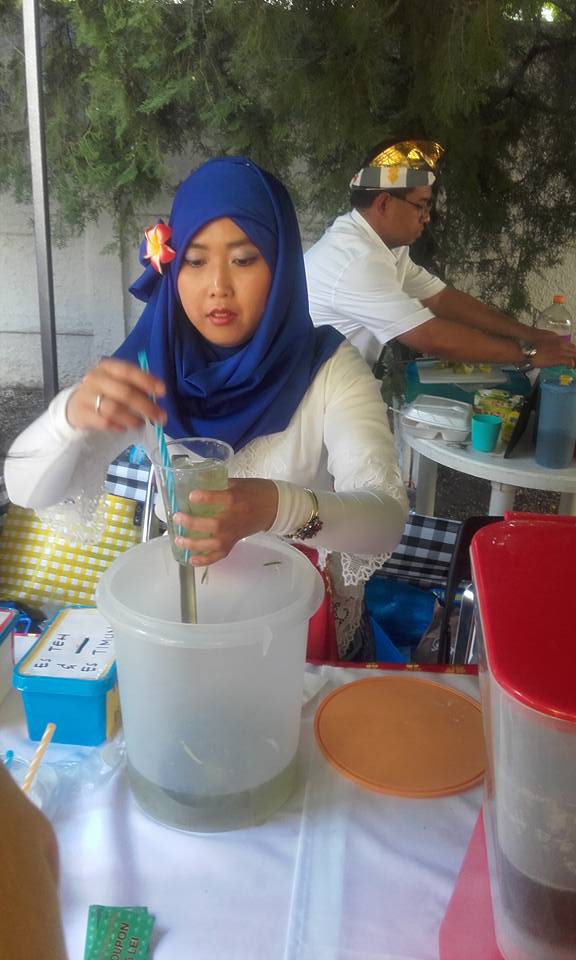
        Said and done: this week-end I popped by the Indonesian Embassy of Bucharest, where the event 'Piața Indonezia' (Indonesia Market) was taking place. It was a cultural event lasting a few hours, around lunchtime and early afternoon.
        Now, I admit that I didn't know much about Indonesia until the recent past. Well, apart from the fact that Bali is a very popular touristic destination. However, the company I work for has an office in Indonesia as well, and I got the chance to interact with colleagues from this country. And most surely, this played a major part in stirring my curiosity.


       The event itself, not being very long, contained short manifestations of various kinds, comprising different aspects of Indonesian culture. Traditional dances and music (and also pop music played by Indonesian musicians), martial arts demonstrations, clothes, handicrafts and souvenirs to buy, and, of course, local food and drinks. 
           What caught my attention especially has to do with the visual part, but also with... taste. And here are my first impressions as an outsider.
             First of all, Indonesia is about colour, flower patterns and gold. That can be noticed in their traditional costumes, and the ornaments and accessories. 


             Indonesia is also ... a friendly country. Or, so it seems, because of the politeness of the people I met, and who always wear a smile. Besides, the way they involved the public in a traditional dance says it all. Plus, let's not forget the statues, masks and mythological creatures which are amusing in themselves. 


              Last but not least, Indonesia is very sweet. On a very hot day like it was last Saturday, cooling off with a (sweet) cucumber punch, or a very fruity drink called Es Teler. The coconut pancakes which I had heard about and which I was really tempted by had finished before I arrived to the food court, but I still managed to buy some tourquoise sponge cake, also with coconut flavour (talk about colours and sweetness).
                 

                The event was interesting, but it was also brief... and overcrowded. The back yard of the Embassy was not that big. Maybe they didn't foresee such high presence, but, on the other hand this demonstrates that people are curious when it comes to culture. For next year, I hope to see more and taste more of Indonesia! 
             

Monday, 9 May 2016

Europe: Unity vs. Utopia

         On Europe Day, I cannot help but wonder how many Europeans accross the continent are really celebrating.  I haven't lost my optimist attittude, but I see an increasing number of social, political and even safety issues that Europe is dealing with. I see more and more skepticism everywhere, amongst people I interact with in daily life.
           For the past two of years, we've seen economic crises, inflows of refugees from North African and Middle Eastern countries, as well as terrorist attacks in Paris and Brussels. Countries are trying to reach a middle ground about almost everything, sometimes forgetting even about the national particularities on each country. Various European states are also turning towards extreme right political regimes, and the UK is contemplating exiting the EU.
          On the beautiful sign of the spectrum, however, we enjoy all the consequences of freedom of movement. Travelling in Europe became increasingly easy, as well as studying and working within the EU, leading people to experience the different cultures of the old continent. Friendships, cultural practices, languages, mixed families... Amongst young people in particular I still see a lot of enthusiasm, as if Europe and European identity were (or maybe they really are?) this wonderful, lifelong project, to cultivate in a wide variety of ways. 
       However, what should be done in order to still experience the beautiful part, but, at the same time, make sure we stay safe, and that modern European values are not jeopardized? Or do you think we'd be better off separating and each country minding its own problems and regulating their own societies, whilst re-creating borders for the outside world. 
        More often than not, we are tempted to link the mass migration of refugees to the terrorist attacks which recently took place. But there are also genuine cases of people fleeing dangerous situations in their home countries. How could we differentiate between the intentions of these immigrants? I recently heard some politician/opinion leader/don't remember exactly who, saying that excessive control or restriction is just as bad as excessive tollerance. In a way, I believe it's true, because when an individual or a community is getting the feeling of not being accepted, anger towards the host country tends to rise even more. On the other hand, if someone arrives already with dangerous intention, authorities not doing anything about it would only create fertile ground for more evil deeds. 
           My personal opinion would be about finding the right balance between clear immigration policies, applied firmly but not aggressively or in petty ways, and increasing the activities of cultural mediation, exerted by official institutions, and, why not, also by each individual. If faced with multiculturalism in any shape or form, we  also have the power to teach our 'outsider' aquaintances what is right and what is wrong on our territory. Or perhaps you think that somebody's individual contribution doesn't really count, and it is just a water drop in the ocean. Or you might also say that it should come from each state's institutions in authority, which at the moment are not doing enough, and they should be more strict about everything? 
                I invite you to think about it... and share with me! :)
          

Monday, 2 May 2016

How to Be an Un-official City Tour Guide


        One of the perks of having travelled substantially accross Europe (and imagine if that expanded to the entire world, but it is not my case yet), is that you get to make a large number of friends spread all over the map. Who, at their turn, will get to visit you or your city at some point in time. Are you ready to organize a city tour, and make your friends familiar with your city, in all seasons? You and I may not be qualified tour guides, who are non-stop walking-talking encyclopedias, but at least we can do the basics in a decent way. Well, I must admit that by now I have gained a fair share of experience, and here is what I learnt.


         ... inform yourself (or refresh your memory) on the most important touristic attractions, and if possible, group them in time and space slots. 
        ... choose the most interesting and pitoresque places, as well as places which highlight the national/local culture. In other words, shopping malls are present everywhere in the world and your friend has them at home too! :) 
        ... learn some factual information on those attractions, in order to present them correctly to your friends. A little bit of history, geography or architecture knowledge goes a long way.


        ... only show and draw attention to what is positive about your city. Don't take your friend to ugly or dangerous places to show him something 'sensational'. That is, if you still want him to come back. So, be a good PR for your city.
        ... choose venues that are suitable for the season and for the weather. Maybe a long walk in the park on a freezing winter day or on a 40 degrees summer lunchtime is a bad idea, just like it is to spend most of the day in closed spaces on a day which is just perfect for outdoor activities.
          .... find out if there are any particular cultural events in town, and take your friend there if you believe they'd be interested. But beware: if there is local language involved, and your friend doesn't speak or understand it, that event wouldn't be your best bet.
      ... when it comes to food, again, choose traditional restaurants. There is no point taking your Italian friend to eat pizza in Romania: he will only find it a bad copy of his own national food. Plus, if you know a restaurant with a traditional artistic programme or atmosphere, that's even better!
          ... keep budget in mind, both when choosing the venues, and, if it is the case, also when you recommend a place to stay. A tourist who is still a student will not have the same budget as a professional of some top-notch company. 
          ... be prepared to be also a translator and an interpreter, if you get to a place where English is not spoken, or if your friend himself does not speak it. 


    ... last but not least, make sure your friend is safe and comfortable all the time. For example, if he arrives alone in the middle of the night at the train station, don't let him find his way to your house by himself, amongst strange faces. Instead, pick him up by car or by taxi. Also, make sure you won't put their health and well-being at risk, and, in case of emergency, act as promptly as you can.
                As you can see, it is not very difficult. All it takes is some advance preparation, good will, consideration, and lots of energy. And of course, don't forget to enjoy your friend's company, and to enjoy the city through their eyes, as if you were experiencing it for the first time as well. The result? You will have fun and create wonderful memories together. And maybe who knows... maybe one day you decide to become a certified tour guide. ;)